
 listicle
Best Guitar Picks for Hand Arthritis: 2026 Guide
Table of Contents
- Quick Comparison: Best Guitar Picks for Hand Arthritis
- How to Hold a Guitar Pick with Arthritis
- Reducing Hand Muscle Fatigue While Playing Guitar
- Crossover Thumb Picks for Universal Picking Technique
- 1. Strum-N-Comfort SharkTooth Crossover Pick: Best Overall
- 2. Strum-N-Comfort Kodiak Crossover Pick: Best for Stability
- 3. The Protagonist Pick: Best Extra-Thick Plectrum
- 4. Dunlop Max Grip Picks: Best Budget Non-Slip Option
- Frequently Asked Questions
Last Updated: September 23, 2026
Quick Comparison: Best Guitar Picks for Hand Arthritis
The best guitar picks for hand arthritis reduce the grip force required to hold a pick steady. For most players, that means an ergonomic thumb pick or a standard thin flat pick.
This guide from Strum-N-Comfort covers options, from adjustable Crossover thumb picks to other flat picks.
Pick | Type | Starting Price | Best For |
|---|---|---|---|
Strum-N-Comfort SharkTooth Crossover | Thumb pick | Contact for pricing | Best overall |
Strum-N-Comfort Kodiak Crossover | Thumb pick | Contact for pricing | Best for stability |
The Protagonist Pick | Extra-thick flat pick | $15.00 | Rolling Off of the String |
Dunlop Max Grip | Textured flat pick | $5.00 | Budget non-slip option |
How to Hold a Guitar Pick with Arthritis
Holding a guitar pick with arthritis starts with reducing holding force, not rebuilding your entire technique. A relaxed grip plus a pick that stays put on its own does more for joint pain than any single adjustment. The goal is to move the work from a pinching thumb and index finger into the larger, stronger structures of the hand and forearm.
Adjusting Your Grip Pressure
Most players grip harder than they need to. That tension travels straight into the thumb joint and wrist. A useful test: strum a chord and slowly loosen your grip until the pick just barely stops rotating. That is your minimum viable grip. Anything tighter is wasted effort that accumulates as joint stiffness.
Alternative Holding Techniques
Three approaches help when a standard pinch grip hurts:
- Thumb-and-index only: Drop the middle finger support and let the pick rest lighter. Fewer contact points means less cumulative pressure on any one joint.
- Thumb pick: Moves the anchor to the thumb, freeing the index finger entirely. This is the single biggest mechanical change most arthritic players can make.
- Angle adjustment: Tilting the pick slightly reduces surface friction against the strings, which lowers the force needed to push through. A shallow angle also lets the pick glide rather than catch.
A common mistake is fighting a pick that wants to spin. If you're constantly re-gripping mid-song, switch to thinner picks before you switch technique. However, your tone is determined by the pick material and thickness.
Customizing Picks for Better Leverage
You do not have to buy a new pick to get relief. Two low-cost modifications help players keep a favorite plectrum:
- Grip tape: A small strip of self-adhesive grip tape or even medical tape on the flat faces adds friction without changing the pick's tone or thickness.
- Moldable silicone: Heat-moldable silicone putty can be pressed onto the pick to build up a custom thumb rest, effectively turning a flat pick into a shaped grip that matches your hand.
Reducing the Force at the Source
The amount of grip pressure you need is partly set by your strings, not just your pick. Heavier strings need more force to move, and that force starts in your picking hand. Stepping down one gauge often means you can play with noticeably less grip pressure and less joint stiffness afterward. If you're set on heavy strings, compensate with a thicker, more rigid pick: a rigid pick transfers energy more efficiently, so you don't have to push as hard. However, thin picks are easier to push through the string, as well, and requires less thumb/finger pinch pressure.
When to Consider a Thumb Pick
If your thumb joint hurts after 20 minutes of flat-pick playing, texture alone will not fix it. A thumb pick moves the anchor to the thumb and removes the pinch grip entirely. Crossover thumb picks are comfortable, flexible, and highly effective in helping develop a Universal Picking Technique, so you can move between fingerstyle and flat-picking without re-gripping.
Reducing Hand Muscle Fatigue While Playing Guitar
Reducing hand muscle fatigue while playing guitar comes down to three things: shorter practice blocks, lighter string tension, and a pick that doesn't demand a tight hold. Strumming fatigue builds from repetition, so small changes compound quickly. A 20-minute block with a two-minute break is easier on the hand than a continuous 40-minute push.
Physical Therapy Exercises for Guitarists
A few minutes of hand care before and after playing goes a long way. These exercises may help with finger joint mobility and hand dexterity:
- Tendon glides: Curl and extend each finger slowly through a full range, 10 reps. This warms the tendons before they take load.
- Thumb opposition: Touch thumb to each fingertip in sequence, 2 sets. This restores the range of motion that a tight pinch grip erodes.
- Wrist extensions: Gentle stretch against light resistance, 20 seconds per side. This releases the forearm tension that feeds into the thumb joint.
Impact of String Gauge on Pick Pressure
Heavier strings need more force to move, and that force starts in your picking hand. Stepping down one gauge often means you can play with noticeably less grip pressure and less joint stiffness afterward. The relationship is direct: thicker strings have higher tension, higher tension resists the pick, and your hand compensates by gripping harder.
Warm-Up Routines Before You Play
Cold hands grip harder. A two-minute warm-up before you play can reduce the force you apply for the rest of the session:
- Run warm water over your hands for a minute, or rub them together until they feel warm.
- Play slow, open-string strums for 60 seconds with the lightest grip you can manage.
- Gradually add fretting and picking complexity rather than starting at full speed.
Reducing Fatigue with Your Pick Choice
A pick that stays put without a hard pinch removes the largest single source of hand fatigue. Both the SharkTooth and Kodiak Crossover Pick models feature a fully adjustable thumb strap system, so the pick stays put without a tight grip. The SharkTooth goes a step further: it lets you use your favorite flat pick with the strap system, so you keep the tone and feel you already like.
Crossover Thumb Picks for Universal Picking Technique
Crossover thumb picks are a category of thumb pick designed to let a player move between fingerstyle and flat-picking without changing hand position. Strum-N-Comfort developed this category around what we call a Universal Picking Technique.
Buy Now at our secure ETSY SHOP music store →
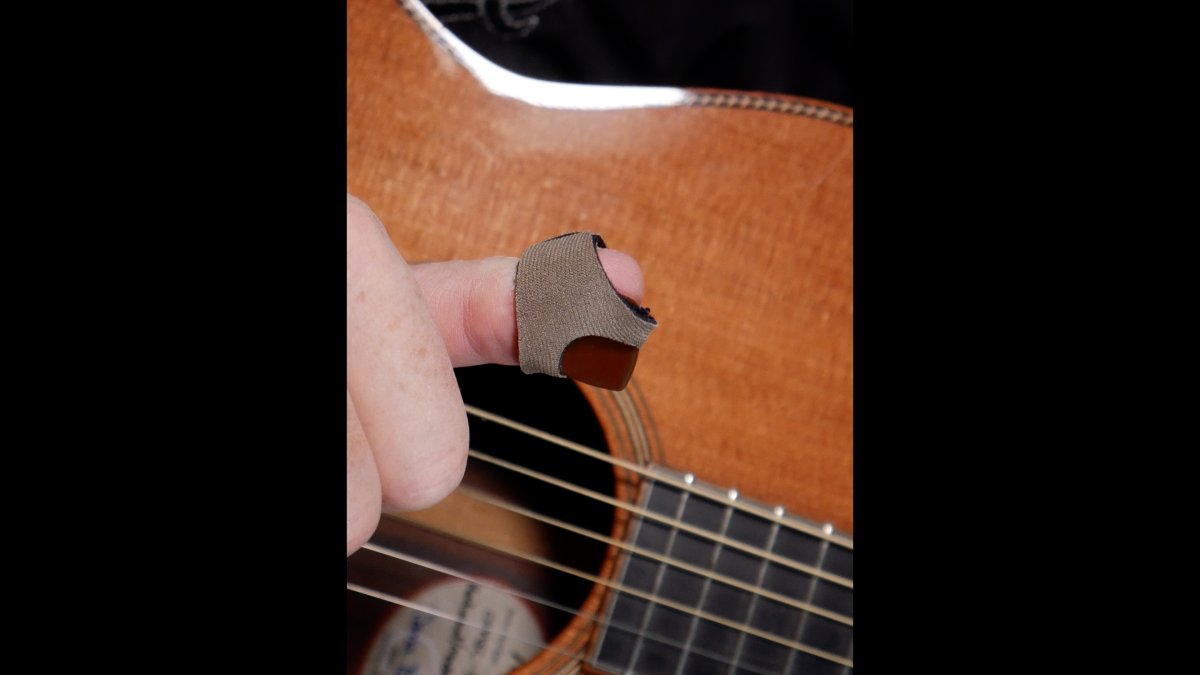
Guitarist wearing a crossover thumb pick with an adjustable strap, one of the best guitar picks for hand arthritis.
1. Strum-N-Comfort SharkTooth Crossover Pick: Best Overall
The SharkTooth is our top pick for arthritic hands because it removes the tight pinch entirely. The fully adjustable thumb strap system holds the pick in place, and you can slot your own flat pick into it.
Key features:
- Fully adjustable thumb strap system
- Works with your favorite flat pick
- Supports a Universal Picking Technique
- Flexible design that reduces hand muscle fatigue
2. Strum-N-Comfort Kodiak Crossover Pick: Best for Stability
The Kodiak trades the flat-pick slot for maximum grip security. Its integrated thumb strap keeps the pick locked in during long practice sessions, which is where stability matters most.
Key features:
- Integrated thumb strap for enhanced stability
- Ergonomic construction to reduce hand muscle fatigue
- Flexible material for a natural playing feel
- Supports a Universal Picking Technique
Cons: Requires the use of the Kodiak flat picks provided
3. The Protagonist Pick: Best Extra-Thick Plectrum
At over 9mm thick, The Protagonist Pick gives you a large surface to hold without fine motor control. It's built specifically for players with arthritis or disabilities.
Key features:
- Over 9mm thick for an easy-to-hold profile
- Ergonomic shape that reduces the need for precise finger placement
- Lightweight construction
4. Dunlop Max Grip Picks: Best Budget Non-Slip Option
If you want to keep a familiar flat pick shape, Dunlop Max Grip is the cheapest way to get a non-slip texture. The molded surface gives you more surface friction, so you need less holding force.
Key features:
- Molded non-slip gripping surface
- Available in several gauges
- Standard shape most players already know
- Durable nylon construction
Frequently Asked Questions
What kind of guitar picks are best for people with arthritis?
The best guitar picks for hand arthritis are typically larger, thicker, and feature ergonomic designs or non-slip textures. Options like Crossover thumb picks, extra-thick plectrums, or picks with molded grips can reduce the holding force required. These designs help minimize joint stiffness and grip pressure, making playing more comfortable and reducing hand muscle fatigue during long sessions.
Do thumb picks help with hand arthritis?
Yes, thumb picks can significantly help with hand arthritis. They eliminate or minimize the need to pinch a flat pick between the thumb and index finger, which is often a source of pain. Ergonomic models like Crossover thumb picks feature adjustable straps that secure the pick to your thumb, requiring almost no grip force. This reduces strain on joints and allows for a more relaxed hand position.
How can I reduce hand pain when playing guitar?
To reduce hand pain, try using lighter gauge strings, taking frequent breaks, and performing physical therapy exercises for hand dexterity. Switching to an ergonomic plectrum or a thumb pick can also help by reducing the need for a tight grip. Additionally, adjusting your pick angle and using a strap to support your instrument can minimize tension and repetitive strain on your hands and wrists.
Can I use my favorite flat pick with a Crossover thumb pick system?
Yes, the Strum-N-Comfort SharkTooth model is specifically designed to let you use your favorite flat pick. The fully adjustable thumb strap system holds the flat pick securely, allowing you to transition seamlessly between fingerstyle and flat-picking techniques. This compatibility means you don't have to give up the tone or feel of your preferred pick while gaining ergonomic benefits.
How do I know if a pick is the right thickness for arthritis?
For arthritis, a thicker pick (often 1.0mm or more) is generally better because it provides stability and requires less grip pressure to hold. Thicker picks also reduce the amount of fine motor control needed, which can help with joint stiffness. However, the best thickness depends on your playing style; experimenting with different gauges is key to finding what reduces your hand fatigue.