
 listicle
Buy Adjustable Thumb Picks for Guitar: 2026 Guide
Table of Contents
- Why Adjustable Thumb Picks Change Your Right Hand Technique
- Quick Comparison: Top Adjustable Thumb Picks for Guitar
- Best Thumb Picks for Fingerstyle Guitarists
- Crossover Thumb Picks for Guitar: A New Category Explained
- How to Fit a Thumb Pick for Comfort and Control
- Materials, Gauge, and Tone: What to Listen For
- Troubleshooting Fit Issues and Transitioning from Flat Picks
- Frequently Asked Questions
Last Updated: September 12, 2026
Why Adjustable Thumb Picks Change Your Right Hand Technique
Most guitarists treat their picking hand as a fixed asset: learn one approach, stay there. Adjustable thumb picks let that hand do both jobs, fingerstyle patterns and flat-pick attack, without swapping gear mid-song. This guide covers how to buy adjustable thumb picks for guitar, what separates a good one from a gimmick, and how to fit them so they disappear into your playing.
A fixed thumb pick locks your thumb into one blade angle and one tension. Fine for pure fingerstyle, but the moment you want hybrid picking or a flat-pick feel, you're fighting your own hand.
A Crossover thumb pick is a thumb-worn pick designed to hold the flat pick provided or your own favorite flat pick while leaving your fingers free for finger-picking technique. That combination enables what we call a Universal Picking Technique, and it's the reason this category exists at all.
Below: the top options, sizing by thumb circumference, and how material and gauge shape your tone.
Quick Comparison: Top Adjustable Thumb Picks for Guitar
The table below compares fit, adjustability, and who each pick suits.
Pick | Adjustability | Best For | Standout Trait |
|---|---|---|---|
Strum-N-Comfort SharkTooth | Fits all thumb sizes | Universal Picking Technique | Holds your own flat pick |
Strum-N-Comfort Kodiak | Fits all thumb sizes | Heavy attack, long sets | Comfortable, flexible build |
Fred Kelly Bumblebee | Adjustable blade angle | Fingerstyle guitarists | Flat-pick feel |
Black Mountain Thumb Pick | Spring-loaded tension | Secure grip seekers | Self-adjusting hinge |
SEPTRIO Metal Set | Bendable metal band | Budget beginners | Multi-piece set |
Open Back Thumb Picks | Heat-molded tension | Long sessions | Ventilated back |
Both Strum-N-Comfort models let you keep the flat pick you already like. The SharkTooth leans toward speed and articulation; the Kodiak toward durability across a long set.
Best Thumb Picks for Fingerstyle Guitarists
The best thumb picks for fingerstyle guitarists balance a warm thumb tone with enough blade control to keep bass lines even. If your thumb pick slips or rotates, your alternating bass pattern falls apart.
Strum-N-Comfort SharkTooth: Universal Picking Technique
The SharkTooth is our top pick for players who switch between fingerstyle and flat-picking constantly. It's a Crossover thumb pick, holding your preferred flat pick in place while your remaining fingers stay free. Comfortable, flexible, and highly effective at developing a Universal Picking Technique, it fits all thumb sizes and works with the flat picks you already own.
What it does well: seamless transitions, less hand muscle fatigue, and a consistent blade angle you set once and forget. The one caveat: the Crossover approach has a short learning curve.
"Definitely an improvement over conventional thumb picks for easily moving between fingerstyle and flat pick techniques." -- Gil Parris, RCA/BMG recording artist
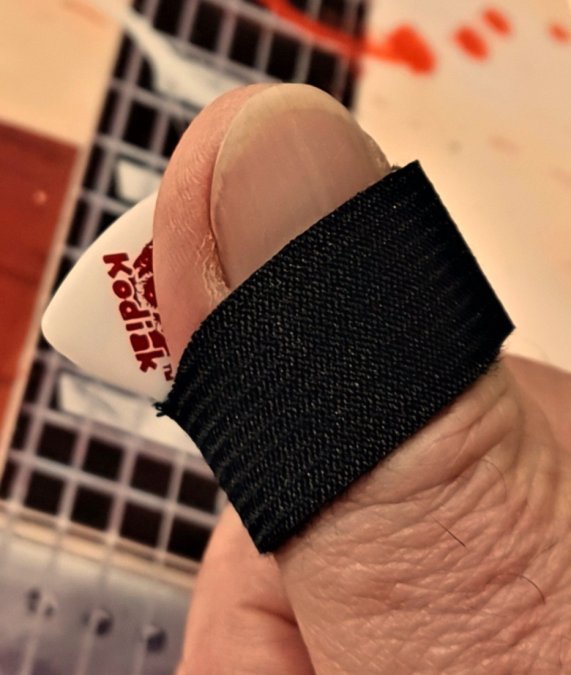
Close-up of a guitarist's right hand wearing an adjustable Crossover thumb pick, natural light catching acoustic guitar strings in the background
Fred Kelly Bumblebee and Other Fingerstyle Options
Crossover Thumb Picks for Guitar: A New Category Explained
I was the first to assign Crossover thumb picks as a category. A conventional thumb pick fuses the blade to the band; a Crossover pick separates those two jobs, the band secures to your thumb, and the blade is a flat pick you insert yourself. Note that both the Kodiak and SharkTooth Crossover pick models come with flat picks already installed.
That distinction changes what you can do mid-performance: you keep the articulation and string attack of your own flat pick, and your fingers stay free for finger-picking and other right hand techniques. Nothing gets swapped, nothing gets dropped.
How to Fit a Thumb Pick for Comfort and Control
Fitting is the single biggest reason a thumb pick ends up in a drawer. It should sit between the base of the thumbnail and first thumb knuckle, snug enough not to rotate, loose enough not to pinch the joint. If you feel it during play, it's too tight.
Start here:
- Slide the band over your thumb so the blade points across your index finger
- Check the blade angle against your natural picking motion, then adjust
- Play a few bars, then re-check. Heat and movement shift the fit
Sizing by Thumb Circumference: A Measurement Guide
The "One size fits all" claim sells thumb picks and, if not true, makes players give up on them. Thumb size doesn't track hand size, height, or gender the way people assume. Measure it directly. You can also try a Crossover thumb pick that has a fully adjustable strap system.
How to measure:
- Wrap a soft measuring tape around the base of your thumb, just above the knuckle and below the thumbnail.
- Keep the tape snug but not compressing the skin. Write the number down in inches or millimeters.
- Measure again in the evening. Thumbs swell slightly over the course of a day, and a pick that fits at 8 a.m. may bind at 8 p.m.
Rough sizing bands (use as a starting point, not a rule):
Thumb circumference | Typical band size | Notes |
|---|---|---|
Under 2.0 in (about 50 mm) | Small / slim band | Often needs a heat-moldable or bendable band |
2.0-2.4 in (about 50-60 mm) | Medium / standard | The most common range for adult players |
Over 2.4 in (about 60 mm) | Large / wide band | Spring-loaded or open-back designs tend to work better |
If you land between bands, size down and adjust tension rather than sizing up and hoping. A band that's too large rotates under the thumb during an alternating bass pattern, the exact failure mode you're trying to avoid.
Troubleshooting Common Fit Problems
Most fit complaints fall into four buckets. Each has a specific fix.
1. The pick rotates or slides off mid-song. Cause: band too loose, or its taper doesn't match your thumb's. Fix: step down a size, or switch to a spring-loaded or heat-moldable band. On Crossover thumb picks the band holds the thumb while your flat pick sits in the blade slot, so a rotating band throws off both the thumb anchor and the flat-pick angle at once. Getting the band right matters more, not less.
2. The thumb aches or goes numb after 20 minutes. Cause: band too tight, or sitting too high near the joint. Fix: slide it down toward the base of the thumb; if it still pinches, go up half a size. Numbness is a circulation signal, not a toughness test, stop and refit.
3. The pick feels dead or the tone is thin. Cause: wrong blade angle, not wrong size. Fix: rotate the blade so it meets the string at the same angle your flat pick would. Small angle changes move the tone more than most players expect.
4. The pick slips only when your hands get warm. Cause: plastic softens with body heat and loses grip. Fix: open-back or ventilated bands run cooler; textured or rubberized inner bands add friction without extra tension.
Ergonomic Fit and Hand Fatigue
Ergonomic fit means the band follows the thumb's natural taper rather than cutting across it, so your thumb isn't constantly gripping to hold it in place. That matters most when combining right-hand techniques, where the thumb anchors fingerstyle patterns while the fingers handle hybrid picking. A comfortable, flexible band lets the thumb relax into its anchor role instead of clenching, what makes a Universal Picking Technique sustainable across a long set.
Materials, Gauge, and Tone: What to Listen For
Material and gauge decide your sound before your technique does. A pick's tone comes from how stiff it is, how fast it returns to shape after the string releases it, and how much high-frequency click it adds at contact. Change any of those three and you change the sound, even with identical technique.
How Material Shapes Tone
Celluloid is the traditional thumb pick material: moderately stiff, warms up quickly in the hand, and produces a rounded attack with a soft top end. It wears faster than modern plastics and is heat-sensitive, but it's the reference tone many fingerstyle players grew up with.
Delrin (acetal) is stiffer than celluloid at the same thickness with a lower coefficient of friction, so there's less pick noise against the string: a warm tone with noticeably reduced click. That's why Delrin shows up so often in hybrid picking, where the thumb should blend with fingers rather than stand out.
Nylon and polycarbonate sit between the two. Nylon flexes more and softens attack; polycarbonate is stiffer and brighter, closer to a metal-adjacent snap without the weight.
Nickel silver and metal frames are the brightest option. Metal doesn't absorb vibration the way plastic does, so more high-frequency energy reaches the ear: sharper attack, clearer note separation, louder projection. The trade-off is weight and a metallic click some players love and others can't unhear.
Ultem and other high-stiffness plastics are the modern middle ground: stiff enough for articulation, light enough to stay comfortable, and durable enough to hold tension across a long set.
Material | Stiffness | Tone Profile | Best For |
|---|---|---|---|
Celluloid | Medium | Warm, rounded | Fingerstyle, softer attack |
Delrin | Medium-high | Warm, low click | Hybrid picking |
Nylon | Low | Soft, mellow | Strumming, beginners |
Polycarbonate | High | Bright, snappy | Articulate lead work |
Nickel silver | Very high | Bright, cutting | Bluegrass, banjo playing |
Metal frame | Very high | Bright, percussive | Volume and projection |
How Gauge Changes Attack and Projection
Gauge works the same way it does on a flat pick: a thinner blade flexes more on contact, spreading energy transfer over a longer window and softening the attack. A heavier gauge stiffens the blade, shortening that window and sharpening articulation.
- Thin (around 0.46-0.60 mm): flexes noticeably, softens string attack, suits strumming and light fingerstyle. Can feel floppy on bass strings.
- Medium (around 0.60-0.88 mm): the all-rounder. Enough stiffness for alternating bass lines, enough flex to stay comfortable on acoustic guitar.
- Heavy (around 0.88-1.50 mm and up): stiff blade, sharp articulation, strong projection. Common for bluegrass, reso-guitar, and any setting where the thumb needs to cut through a mix.
For players combining right-hand techniques, gauge interacts with technique directly. A Crossover thumb pick holds your own flat pick in the blade slot, so the gauge you already trust carries over. You're not re-learning how a blade feels; you're adding an adjustable thumb anchor and freeing your fingers for finger-picking technique. That continuity is why a Universal Picking Technique develops faster than switching between two separate picks.
Troubleshooting Fit Issues and Transitioning from Flat Picks
Fit problems have three usual causes: a pick that rotates means the band is too loose; one that aches after twenty minutes is too tight or sitting too high on the thumb; one that feels dead usually has the wrong blade angle, not the wrong size.
Coming from flat picks, expect a short adjustment period: your thumb learns a new anchor point and your fingers learn they're now free. Most players settle within a few sessions. If you want a band that's built for that transition from the start, our Custom Crossover thumb picks are made for exactly this, combining fingerstyle and flat-picking in one motion.
Frequently Asked Questions
What is the advantage of an adjustable thumb pick over a fixed one?
Adjustable thumb picks let you change tension and fit as your thumb warms up or swells during a set. Fixed picks rely on heat-molding or bending, which weakens plastic over time. An adjustable model keeps steady pressure without slipping, and it works with your own flat picks so you can switch between fingerstyle and flat-picking without changing your right-hand setup.
How do I know what size thumb pick I need?
Measure the circumference around the base of your thumb with a soft tape or a strip of paper. Most adjustable picks cover a universal range, so exact sizing matters less than tension control. If you have small hands, look for a model with a self-adjusting hinge or spring-loaded band that grips without pinching. Strum-N-Comfort Crossover thumb picks fit all thumb sizes.
Can thumb picks help with hand muscle fatigue?
Yes. A pick that fits well reduces the grip force your thumb and wrist use to hold it steady. David Oakes, former Musicians Institute instructor, said after a few hours of play the SharkTooth Pick produces less muscle fatigue. Adjustable tension and an ergonomic fit spread pressure evenly, which matters most during long practice sessions or live sets.
Do professional guitarists use thumb picks?
Many do, especially fingerstyle, banjo, and hybrid picking players. Gil Parris, RCA/BMG recording artist, called the SharkTooth Crossover Pick an improvement over conventional thumb picks for moving between fingerstyle and flat pick techniques. The key is finding a pick that stays secure while letting your fingers move freely for articulation and string attack.
How secure are adjustable thumb picks during a live set?
Security depends on tension and fit. Our Crossover thumb picks are designed to hold firm without cutting off circulation, so the pick stays put when you strum hard. Practice with the pick for a few sessions to confirm it stays comfortable through sweat and long sets.