
 comparison
Are Thumb Picks Better for Fingerstyle? A 2026 Guide
Table of Contents
- Thumb Picks vs. Bare Flesh: The Core Trade-Off
- How to Use a Thumb Pick for Beginners
- Crossover Thumb Pick Benefits: A Universal Picking Technique
- Improving Fingerstyle Speed and Accuracy
- Materials, Shapes, and the Fit Problem
- Ergonomics, Fatigue, and Injury Prevention
- Conclusion
- Frequently Asked Questions
Last Updated: September 19, 2026
Thumb Picks vs. Bare Flesh: The Core Trade-Off
Whether thumb picks are better for fingerstyle comes down to what you need from your right hand. Bare flesh gives warmth and control; a thumb pick gives volume, attack, and consistency.
The honest answer: are thumb picks better for fingerstyle depends on your genre, guitar, and how hard you play. A solo arrangement on a cedar-topped acoustic often sounds better with flesh; a driving Travis picking pattern in a loud room needs the pick.
Most guides treat this as a binary choice.
Tone: Bright Attack vs. Warmth
Flesh produces a soft, rounded note with fast decay; a thumb pick gives a sharper attack, more high-end, and longer sustain.
Volume, Projection, and Dynamic Range
Volume is where thumb picks win outright. A thumb pick moves the string further and releases it faster, producing more acoustic output without extra effort, buying you dynamic range so you can play quietly and still dig in for accents.
How to Use a Thumb Pick for Beginners
Learning how to use a thumb pick for beginners is mostly about fit and patience. Get the fit right, then give your hand two weeks to adapt before judging results.

Diagram illustrating correct thumb pick angle and hand posture for fingerstyle guitarists learning to play
The Universal Starting Sequence
Start here regardless of genre:
- Slide the pick onto your thumb so the blade sits level with the nail, angled slightly toward the strings.
- Play a slow alternating bass pattern for five minutes. Do not worry about speed.
- Add your index and middle fingers on the treble strings once the thumb feels stable.
- Increase tempo only after the thumb stops catching on the string.
- Practice switching to a flatpick grip in the same session if you play both styles.
Genre-by-Genre: When a Thumb Pick Is the Right Call
The answer to "are thumb picks better for fingerstyle" changes completely depending on what you play.
Fitting and Break-In: The First Two Weeks
A common mistake is buying a fixed-size thumb pick and forcing it to work. Traditional picks come in small, medium, and large, none match a thumb between sizes.
Why an Adjustable System Shortens the Learning Curve
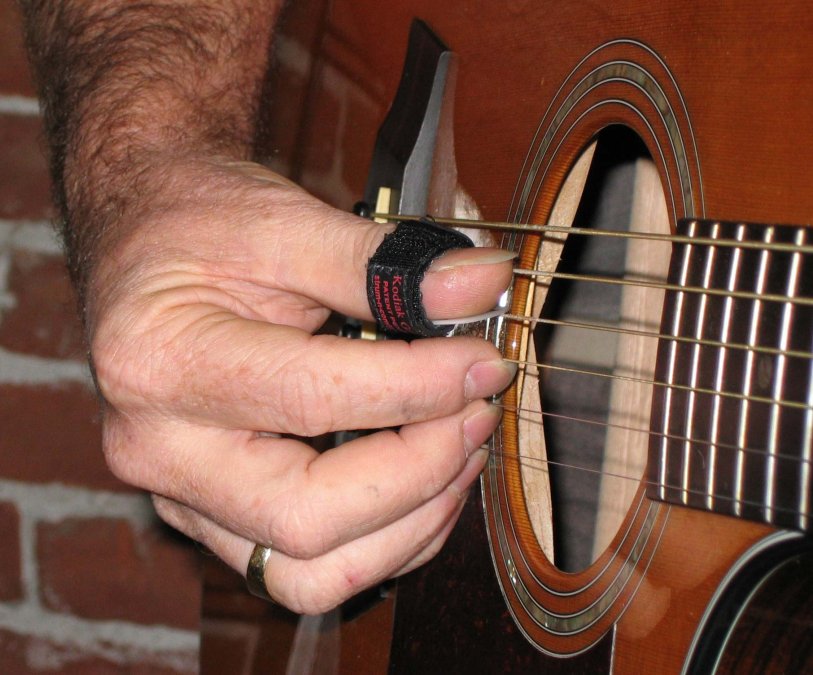
A fixed-size pick asks your thumb to adapt to it. An adjustable strap system adapts to your thumb instead. Both the SharkTooth and Kodiak Crossover Pick models feature a fully adjustable thumb strap system, and the SharkTooth lets you use your favorite flat pick with the strap system. Comfortable, flexible Crossover thumb picks are highly effective at helping players develop a Universal Picking Technique, one right-hand setup that moves between fingerstyle, flatpicking, and hybrid picking without a swap.
Crossover Thumb Pick Benefits: A Universal Picking Technique
Crossover thumb picks are a newer category of thumb pick built around a fully adjustable thumb strap system rather than a fixed plastic shell. The goal is a single tool that handles fingerstyle, flatpicking, and hybrid picking without a swap, what I call a Universal Picking Technique. Strum-N-Comfort developed the Crossover thumb pick category around exactly this problem.
Approach | Switching Speed | Fit | Uses Your Own Flat Pick |
|---|---|---|---|
Bare flesh | Instant | N/A | No |
Traditional thumb pick | Slow | Fixed sizes | No |
Crossover thumb pick | Fast | Adjustable strap | Yes (SharkTooth) |
Improving Fingerstyle Speed and Accuracy
Improving fingerstyle speed and accuracy starts with removing variables, not practicing faster. Every time your thumb pick shifts, your hand makes a micro-correction that costs timing. Speed is about eliminating corrections that interrupt the pattern.
Three things move the needle:
Buy Now at our secure ETSY SHOP music store →
- Consistent blade position. If the blade sits in the same spot every time, your thumb learns the distance to the string.
- Relaxed grip. Tension in the thumb travels up the forearm and slows everything down.
- Isolated thumb practice. Play bass lines alone until the thumb is independent of the fingers.
Travis Picking and Alternating Bass
Travis picking and alternating bass expose every weakness in your thumb setup: the thumb holds a steady pulse while the fingers play syncopated melody on top.
Materials, Shapes, and the Fit Problem
Materials and shapes decide most of the tone argument before technique enters the picture, but fit decides whether you can actually play.
Material: What Each One Does to Your Attack
- Celluloid. The traditional choice. Warm, slightly rounded attack, moderate flex. It wears at the tip over months, slowly changing your tone.
- Delrin. Denser and slicker than celluloid. Slightly softer attack than hard plastics, very consistent release, holds its shape longer.
- Nylon and polycarbonate blends. Lighter and more flexible. Good if you want the pick to give slightly on hard bass notes instead of clicking.
- Ultem and other hard engineering plastics. Bright, stiff, and loud. Great for projection in a jam; unforgiving on a bright small-body guitar.
- Metal (usually brass or nickel-silver). The brightest option, with a banjo-like click, plus noticeable weight on the thumb that changes how your thumb moves.
A useful rule: the harder and stiffer the material, the more your thumb technique gets exposed. Soft materials hide inconsistency. Hard materials broadcast it.
Shape: Blade Length, Angle, and Wrap
- Blade length controls string contact. A short blade plays faster and quieter; a long blade produces more output and more drag.
- Blade angle controls attack. A blade that points slightly down toward the strings gives a cleaner release; a blade that sits flat tends to catch.
- Wrap style controls stability. A full wrap grips more of the thumb but restricts movement. A partial wrap moves freely but rotates.
The Fit Problem Nobody Solves With a Fixed Size
Traditional thumb picks come in small, medium, and large. Real thumbs don't. Thumb length, knuckle size, and taper vary far more than three sizes can cover, which is why so many players describe the same experience: the pick fits at the base and floats at the tip, or fits the tip and pinches the knuckle. A pick that rotates mid-song is worse than no pick at all, your hand spends the whole song correcting instead of playing.
How to Heat-Mold a Plastic Thumb Pick for a Custom Fit
Most plastic thumb picks (celluloid, Delrin, and similar thermoplastics) soften in hot water and can be reshaped. Work carefully:
- Heat water to just below boiling, hot enough that you wouldn't hold your hand in it, but not a rolling boil. Boiling water can distort or discolor some plastics.
- Dip only the wrap portion of the pick for 10-20 seconds. Keep the blade out of the water so it stays flat.
- Lift it out with tongs or a spoon and let it cool for two or three seconds until it's warm but not scalding.
- Slide it onto your thumb and hold it in the position you actually play in, thumb relaxed, not clenched.
- Hold for 20-30 seconds while it cools and sets around your thumb shape.
- Test it. If it's still loose, repeat. Most picks tolerate two or three rounds before the material gets brittle.
Where an Adjustable Strap Changes the Equation
Heat-molding solves fit for one thumb on one pick. An adjustable strap system solves it differently: the strap holds the blade at a consistent angle regardless of thumb shape, so rotation disappears without reshaping anything. Both the SharkTooth and Kodiak Crossover Pick models use a fully adjustable thumb strap system, and the SharkTooth also lets you slide in or insert your own favorite flat pick.
Ergonomics, Fatigue, and Injury Prevention
Ergonomics and injury prevention get almost no coverage in thumb pick discussions, and that's a mistake. Repetitive strain in the thumb and forearm builds slowly, showing up as fatigue long before pain. A pick that doesn't fit forces constant grip pressure, and over a two-hour session that adds up.
Signs worth watching:
- Thumb fatigue within the first 20 minutes of playing
- Forearm tension that doesn't release between songs
- Needing to shake out your hand during a set
- Loss of accuracy late in a practice session
Conclusion
The right-hand technique question never fully resolves, because tone and volume pull in opposite directions. What you can control is the tool. A pick that fits properly lets you focus on the music instead of your grip.
Frequently Asked Questions
Do professional guitarists use thumb picks?
Many do, especially fingerstyle and country players who need consistent bass note articulation and projection. A thumb pick keeps the low strings audible without forcing the thumb to dig in, which matters in solo acoustic settings. Others prefer bare flesh for a softer timbre. The choice often comes down to genre and volume needs rather than skill level, and plenty of pros switch between both depending on the song.
Is it harder to learn fingerstyle with a thumb pick?
The first week or two feels awkward because the pick changes your thumb's angle of attack. After that, most players adjust faster than expected. Start with slow Travis picking patterns and focus on clean alternating bass notes before adding syncopation. A pick with an adjustable strap, like Crossover thumb picks, lets you fine-tune fit so the blade sits consistently, which shortens the learning curve considerably.
Can you use a flat pick with a thumb pick?
With most traditional thumb picks, no. The molded blade gets in the way. Crossover models solve this with a strap system that holds your own flat pick, so you can switch between flatpicking and fingerstyle mid-song. The SharkTooth Crossover Pick is built specifically for this, letting you keep your preferred pick gauge and material while gaining thumb independence for fingerstyle passages.
Does using a thumb pick help with hand fatigue?
It can, because the pick produces volume with less thumb force than bare flesh requires. Less gripping and digging means less strain over long practice sessions. Ergonomics matter too: a secure, adjustable strap reduces the urge to clamp down. Players switching from tight traditional picks often notice the difference within a few hours of play, though individual results vary with technique and hand size.