
 how-to
How to Maintain Consistent Guitar Picking Tone
Table of Contents
- Why Your Picking Tone Changes (And How to Hear It)
- Guitar Pick Grip and Angle: The Foundation of Consistent Tone
- Guitar Picking Depth: How Far Past the String Should You Go?
- Alternate Picking Exercises That Build Even Tone
- Flatpicking and Fingerstyle Transition: Keeping Tone Steady When You Switch
- How Pick and String Variables Affect Your Tone Consistency
- A Structured Practice Routine for Tone Consistency
- Conclusion: Building a Universal Picking Technique
- Frequently Asked Questions
Last Updated: October 6, 2026
Why Your Picking Tone Changes (And How to Hear It)
Your guitar picking tone changes because three things keep shifting: how hard you grip the pick, the angle it hits the string, and how deep it travels past the string.
Most tone problems are not random. They follow patterns you can spot in minutes. Play a single note on your low E string, then the same note on your high E string.
The Three Variables That Control Every Note
Pick grip is how tightly your thumb and index finger hold the pick. Pick angle is how the pick meets the string. Pick depth is how far the pick travels past the string before release. Change any one and your tone changes with it, often without you noticing. The fix is not "try harder", it is controlling one variable at a time.
Guitar Pick Grip and Angle: The Foundation of Consistent Tone
Guitar pick grip and angle decide how your pick releases the string, and that release shapes every note.
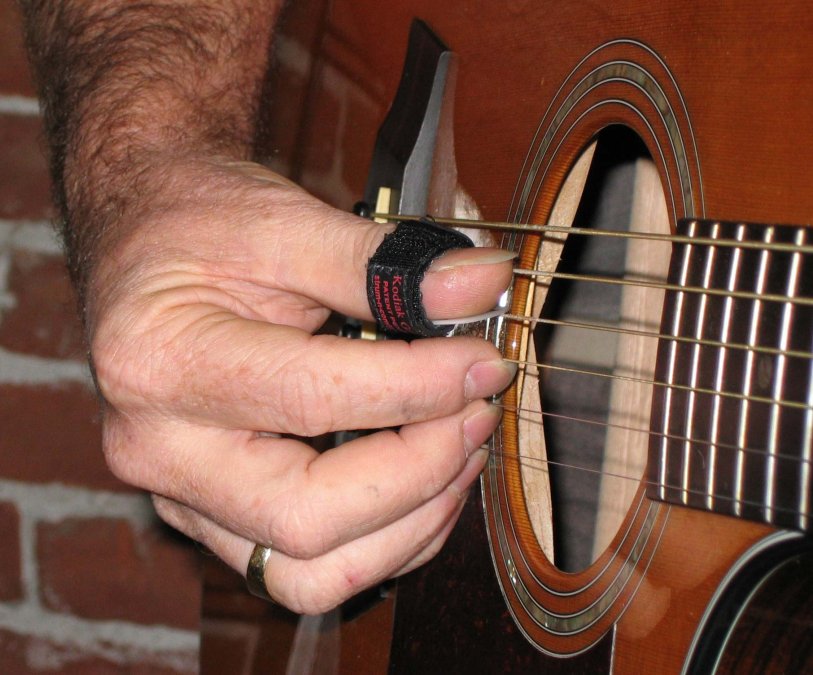
Close-up of a guitarist's right hand holding a Crossover thumb pick at a slight angle against acoustic guitar strings, showing relaxed grip and natural wrist position
Try this test. Strum a chord with your normal grip, then loosen slightly and strum again. Most players hear a warmer, fuller tone on the second pass.
How Much Pressure Is Too Much?
If your fingertips turn white, you are gripping too hard. If the pick spins, too soft. Aim for the middle: the pick stays put but still moves a little when it hits a string. Here is a simple checklist for grip and angle:
- Thumb pad sits flat on the pick, not on its edge
- Only the tip of the pick shows past your fingers
- Wrist stays loose, not locked
A common mistake is squeezing harder as you speed up. Speed should come from the wrist, not grip pressure.
Guitar Picking Depth: How Far Past the String Should You Go?
Guitar picking depth should stay shallow, roughly 2 to 3 millimeters past the string for most playing. Deeper picks dig in, slow you down, and create a louder, harsher attack that is hard to repeat. Shallow depth gives you two wins: less resistance means less hand tension, and the pick returns to the same spot every time, so your tone stays even.
Alternate Picking Exercises That Build Even Tone
Alternate picking exercises build even tone when you practice them slowly and listen for matching downstrokes and upstrokes. Speed is not the goal, evenness is. Most players have a louder downstroke than upstroke, the number one cause of uneven tone, and it usually traces back to one of four causes. Diagnose which one you have before you drill.
Diagnose the Imbalance Before You Drill
Record eight downstrokes and eight upstrokes on one open string at a slow tempo, then listen for these patterns:
- Downstroke louder, upstroke thinner. Your pick angle changes between directions. The pick is likely flat on the downstroke and angled on the upstroke, or the reverse.
- Upstroke louder, downstroke weaker. Your wrist is doing the work on the upstroke and your elbow is doing it on the downstroke. The two motions produce different attack.
- Both directions uneven note to note. Your grip pressure is drifting. This is the most common cause and the hardest to hear in real time.
The Direction-Matching Drill
- Pick one open string at a slow tempo, around 60 beats per minute with one note per beat.
- Play eight downstrokes, then eight upstrokes.
- Listen for volume and tone differences between the two groups.
- Adjust your grip and angle until they match.
- Add alternate picking only after the two directions sound alike.
If they still do not match after several passes, play only downstrokes for a full minute, then only upstrokes for a full minute. The direction that fatigues faster is generating the tone drift.
The Metronome Progression Method
Set your metronome at a tempo where you can play cleanly with zero mistakes, slower than you expect. Play for one minute. If every note sounds the same, raise the tempo slightly; if any note sounds different, drop back down. You only earn a tempo increase when the tone is even, not when the notes are merely correct.
Cross-String Consistency Check
Even tone across a single string is only half the job. Play a two-octave scale slowly and listen for volume jumps when you move from wound strings to plain strings. Plain strings have less mass and respond differently to the same pick depth, so most players unconsciously dig deeper to compensate, producing a brighter, harsher attack. This is the same principle behind a Universal Picking Technique: one motion, one depth, one grip, applied across every string and every style.
Flatpicking and Fingerstyle Transition: Keeping Tone Steady When You Switch
Flatpicking and fingerstyle transition is where tone consistency breaks down for most players. You spend months building a flatpick sound, then switch to fingerstyle and the volume drops. The problem is contact: a pick hits the string with a hard edge, a fingertip with soft flesh or hard nail, and those sounds will never match perfectly. What you can do is close the gap:
- Keep your picking hand close to the strings in both styles
- Match your attack strength between pick and fingers
- Practice switching mid-song, not just between songs
This is exactly where a Crossover thumb pick helps. Our comfortable, flexible Crossover thumb picks let you move between fingerstyle and flat-pick techniques without changing your hand position.
David Oakes, former Musicians Institute instructor, put it simply: "After just a few hours of play, I can truly say that this SharkTooth Pick produces less muscle fatigue."
How Pick and String Variables Affect Your Tone Consistency
Pick and string variables change your tone before your hand ever touches the guitar. Thickness, material, shape, wear, and string gauge all matter, and most players change several at once without realizing it, which is why tone problems feel random when they are not. Every pick variable changes how much the pick flexes at release: more flex means longer string contact and a softer attack, less flex means a shorter, sharper contact and a brighter attack.
Pick Thickness
A thin pick, roughly under 0.60 mm, flexes noticeably and gives a softer, rounder attack. A thick pick, roughly over 1.00 mm, stays rigid and produces a sharper, more articulate sound. Medium picks sit between the two and are the most common starting point for players chasing consistency. The trade-off is control versus forgiveness: thin picks are forgiving on strumming but flex unpredictably at higher volumes, while thick picks give repeatable depth but expose every inconsistency in your grip and angle.
Buy Now at our secure ETSY SHOP music store →
Pick Material
Material changes both the attack and how quickly the pick wears. Common materials include celluloid, nylon, Delrin, Ultem, and various composites. Each has a different stiffness-to-flex ratio, so two picks of the same thickness can sound completely different. Players often switch materials looking for a tone fix when the real issue is grip pressure. Test one material at a time and keep everything else constant.
Pick Shape and Tip
A pointed tip concentrates force on a smaller contact area and produces a brighter, more defined attack. A rounded tip spreads the force and produces a warmer, softer sound. Shape also affects how the pick releases the string, which changes how much depth you need for a clean note.
Pick Wear
Worn picks are the sneaky variable. A rounded, polished edge sounds noticeably duller than a fresh edge, and the change happens gradually enough that most players do not notice until the tone is already gone. Check your pick every few weeks. If the tip looks rounded instead of pointed, swap it out.
String Gauge and Age
Heavier string gauges resist the pick more, increasing flex and softening the attack. Lighter gauges flex less and produce a brighter, more immediate response. Old strings lose brightness and turn your tone muddy, so change them on a regular schedule rather than chasing a tone problem that lives in your strings.
The Variable Isolation Protocol
You cannot diagnose a tone problem if you change three things at once. Use this protocol:
- Pick one pick and one set of strings. Write down the thickness, material, and gauge.
- Play the same short phrase and record it.
- Change exactly one variable. Record again.
- Compare the recordings. If the tone changed, you know what that variable does.
- Repeat for each variable you care about.
Most players find grip pressure and pick angle matter more than any equipment change, good news, because those are free to fix.
Variable | Effect on Tone | What to Do |
|---|---|---|
Pick thickness | Thin = softer, thick = sharper | Pick one thickness and stay with it |
Pick material | Changes attack and flex | Test one material at a time |
Pick shape | Pointed = brighter, rounded = warmer | Match shape to the sound you want |
Pick wear | Worn edge = dull sound | Replace when the tip rounds off |
String gauge | Heavy = softer attack, light = brighter | Stay on one gauge while practicing |
String age | Old strings = muddy tone | Change on a set schedule |
A Structured Practice Routine for Tone Consistency
Minutes 1-5: Grip and angle check. Play slow single notes.
Minutes 6-10: Depth drill. Play with a shallow pick depth.
Minutes 11-15: Alternate picking. Use the metronome progression method. Match downstrokes and upstrokes.
Minutes 16-20: Style switching. Move between flatpicking and fingerstyle. Listen for volume consistency.
To measure progress, record the same short phrase at the start of each week.
Conclusion: Building a Universal Picking Technique
Tone consistency is not a talent. It is a habit built from controlled grip, shallow depth, steady angle, and slow practice.
That is what we call a Universal Picking Technique, and it is the whole reason Strum-N-Comfort exists. Our Crossover thumb picks are comfortable, flexible, and highly effective at helping you develop it.
Get started with Strum-N-Comfort and build a picking technique that stays even across every style you play.
Frequently Asked Questions
How do I make my guitar picking sound more consistent?
Focus on three things: grip pressure, pick angle, and picking depth. Keep your grip relaxed but firm enough that the pick does not shift. Hold the pick at a slight angle (10-20 degrees) rather than flat against the string. Limit how far the pick travels past the string to about 2-3 millimeters. Practice slowly with a metronome, listening for even volume and tone across every note. Record yourself to catch inconsistencies you might not hear in the moment.
How deep should a guitar pick go past the strings?
For most players, 2-3 millimeters of pick depth past the string gives the best balance of tone and control. Going deeper creates a louder, darker attack but slows you down and makes consistent tone harder to maintain. Shallow picking (1 millimeter or less) produces a brighter, thinner sound but risks missing strings entirely. Experiment to find your sweet spot, then practice keeping that depth consistent across all six strings.
Does the thickness of a guitar pick affect tone?
Yes. Thicker picks (1.0mm and above) produce a fuller, warmer tone with more volume and less flex. Thinner picks (0.5-0.7mm) create a brighter, snappier sound but bend more, which can make consistent attack harder. For tone consistency, medium to heavy picks (0.88-1.14mm) work well because they resist flexing and deliver even energy to the string. The key is picking one thickness and sticking with it long enough to develop muscle memory.
How can I switch between flatpicking and fingerstyle smoothly?
The transition feels awkward because your right hand has to change roles mid-song. Practice switching at slow tempos first, giving yourself time to move between techniques. A Crossover thumb pick like the SharkTooth or Kodiak helps because it stays on your thumb and lets you use your fingers or a flat pick without swapping gear. The adjustable strap system keeps the pick secure, and the design reduces hand fatigue during long practice sessions.