 ultimate-guide
How to Develop Universal Picking Technique: 2026 Guide
Table of Contents
- What Universal Picking Technique Actually Means
- How to Hold a Guitar Pick Optimally for Both Styles
- Crossover Thumb Pick Benefits for Switching Between Fingerstyle and Flat-Picking
- Alternate Picking Mechanics: Downstroke, Upstroke, and Economy of Motion
- Reducing Hand Fatigue While Playing Guitar
- Hybrid Picking Exercises to Build Finger Independence
- Metronome Practice Routines and Deliberate Practice
- Common Mistakes and How to Fix Them
- Frequently Asked Questions
Last Updated: September 27, 2026
What Universal Picking Technique Actually Means
Universal picking technique is the ability to move between fingerstyle and flat-picking without changing your grip, resetting your hand, or losing your place on the strings. It combines three right-hand skills into one fluid motion. Most players treat fingerstyle and flat-picking as two disciplines, that mental split is the problem.
The three right-hand skills you are combining are:
- Thumb independence for bass lines and steady patterns
- Flat-pick control for single-note lead work and rhythm strumming
- Finger independence for hybrid picking and string skipping
How to Hold a Guitar Pick Optimally for Both Styles
To hold a guitar pick optimally for both fingerstyle and flat-picking, grip it between thumb and index finger with only the tip exposed, roughly 2-3 mm past your thumb pad. Keep the wrist loose and let the pick angle slightly toward the strings. Squeeze too hard and your hand fatigues within minutes; too loose and the pick rotates mid-phrase.
Grip Pressure, Pick Angle, and Anchor Points
Anchoring the pinky hard against the guitar body locks the hand into one position and kills your ability to shift between picking and fingerstyle; a light anchor or floating hand keeps options open. Pick angle also changes tone and speed: a slight downward slant creates less resistance on the downstroke, helping economy of motion and alternate picking at higher tempos.
- Anchor points: light contact, never locked
- Pick angle: slight slant, not flat
- Grip pressure: firm enough to control, loose enough to breathe
Crossover Thumb Pick Benefits for Switching Between Fingerstyle and Flat-Picking
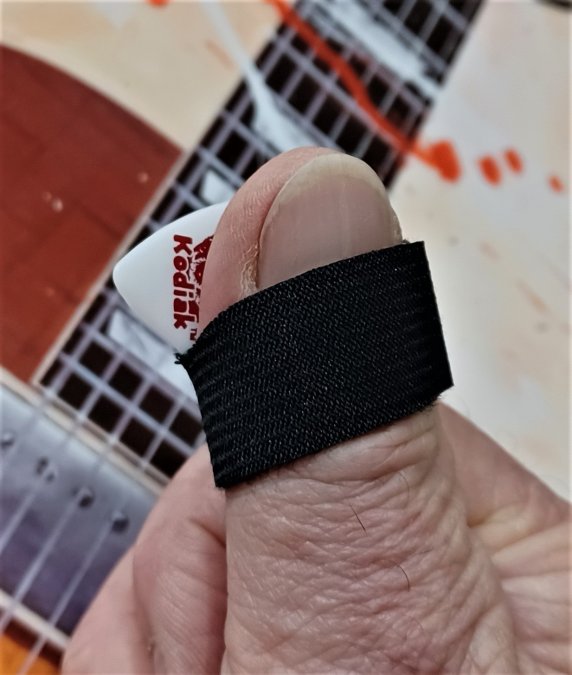
Crossover thumb picks are a category of thumb pick designed to let a player move between fingerstyle and flat-picking without swapping gear. The Strum-N-Comfort SharkTooth and Kodiak models both feature a fully adjustable thumb strap system, and the SharkTooth models let you use your favorite flat pick with the strap system attached.
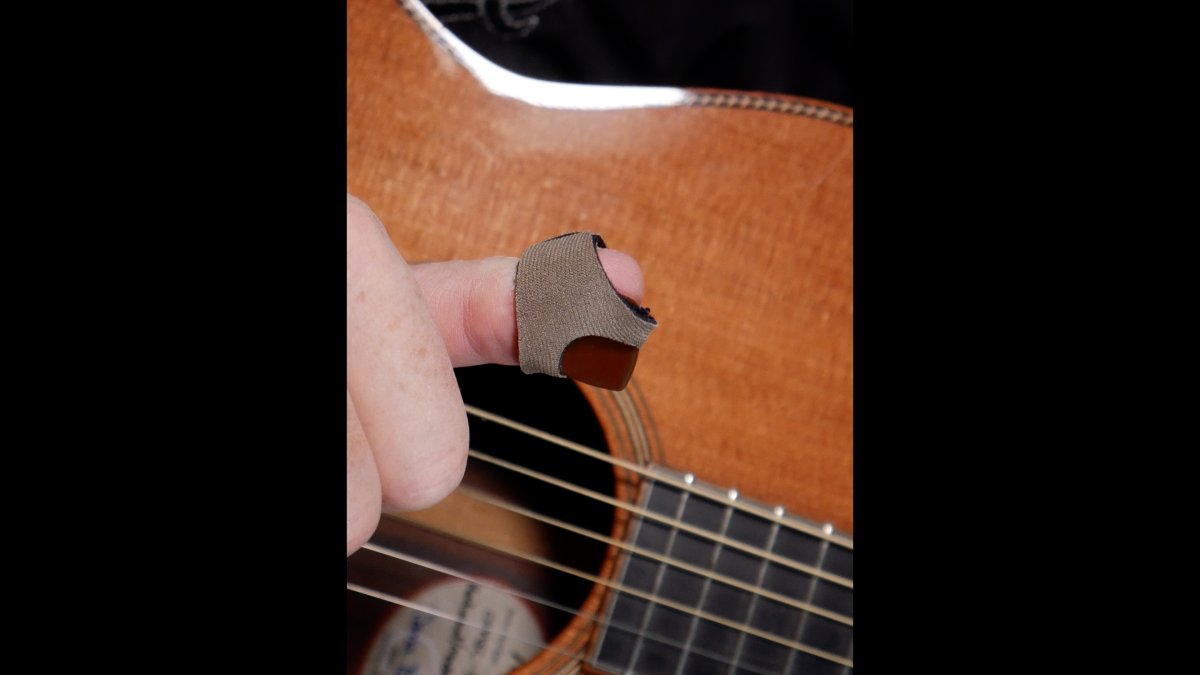
Guitarist using a Crossover thumb pick for universal picking between fingerstyle and flat-picking techniques.
Alternate Picking Mechanics: Downstroke, Upstroke, and Economy of Motion
Alternate picking mechanics come down to one rule: every downstroke and upstroke should travel the same distance at the same angle. When the pick path stays consistent, your hand stops making micro-corrections and speed follows. The most common breakdown happens at string changes, that hesitation is a motion problem, not a speed problem.
The Three Motions You Are Choosing Between
There are three ways to drive an alternate-picking stroke, and most players blend them unknowingly:
- Wrist rotation: the forearm stays fairly still and the wrist turns like a doorknob. This is the default for most single-note lines and the easiest to keep small.
- Elbow motion: the forearm swings from the elbow. Useful for wide, aggressive rhythm work, but it travels farther and fatigues faster at high tempos.
- Finger and thumb motion: the pick moves mostly from the thumb and index finger. This is the smallest motion and the one that lets you keep going when your wrist tightens up.
String-Change Mechanics: The Real Speed Killer
Inside a single string, alternate picking is nearly automatic. The difficulty is the crossing. There are two ways to cross a string, and they are not interchangeable:
- Outside picking: the pick starts on the outside of the string pair and moves inward. This is the more natural crossing for most players.
- Inside picking: the pick starts between the two strings and moves outward. This is the one that trips people up, because the pick has to reverse direction in a tight space.
A Concrete Alternate-Picking Drill
- Set a metronome to 60 BPM.
- Play continuous eighth notes on one string for one minute. Listen for even volume on down and up strokes.
- Move to a two-string pattern (for example, the low E and A strings) and play the same eighth notes, crossing on every other note.
- Repeat on each adjacent string pair until you have covered all six.
- Only when every pair is clean at 60 BPM do you add 5 BPM.
Visual Diagnostic: Find Your Picking Plateau
Use the symptom to find the cause:
Symptom | Likely Cause | Fix |
|---|---|---|
Hitting adjacent strings | Pick path is arcing, not straight | Slow down and watch the pick travel in a straight line |
Volume drops on upstrokes | Upstroke travels farther than downstroke | Match the two strokes in front of a mirror |
Hand locks up past a certain tempo | Elbow motion taking over | Switch to wrist or finger motion and rebuild |
Clean on one string, messy on the next | Inside-picking transition | Isolate that string pair at half speed |
Fatigue after a few minutes | Over-gripping or oversized motion | Loosen grip, shrink the motion |
Economy of motion separates players who sustain tremolo picking for a full solo from those who burn out after eight bars: smaller motion, more control, less tension. A pick that sits securely on your thumb without a death grip lets you relax the hand that drives every stroke.
Reducing Hand Fatigue While Playing Guitar
Reducing hand fatigue starts with grip pressure and setup, not with playing less. Most fatigue comes from over-gripping the pick and holding forearm tension that never releases between notes.
Three habits that cut fatigue fast:
- Check your grip every few minutes and loosen it deliberately
- Shake out your hand between songs, not just between sets
- Match your pick thickness and shape to the style you are playing
Hybrid Picking Exercises to Build Finger Independence
Hybrid picking exercises build the connection between your flat pick and your remaining fingers, the bridge between flat-picking and full fingerstyle. Start slow, keep the pick and fingers synchronized, and resist speeding up before the pattern is clean. The goal is to make the pick and fingers feel like one hand, which only happens when both move from the same relaxed grip.
Buy Now at our secure ETSY SHOP music store →
Exercise 1: The Alternating Thumb Pattern
Play a bass note with your thumb, then a higher note with your index finger, alternating steadily at a tempo you can play cleanly for a full minute. This builds the thumb independence that fingerstyle and universal picking both depend on.
Exercise 2: Flat Pick Plus Middle Finger
Pick a note with your flat pick, then immediately pluck the next string with your middle finger, keeping both motions the same size. This trains the coordination between pick attack and finger articulation that hybrid picking requires.
Exercise 3: String Skipping With Pick and Fingers
Play a note with the pick on the low E string, skip the A string, and pluck the D string with your middle finger. Then reverse: pick the D string and pluck the low E with your thumb. This exposes whether your pick hand and finger hand are truly independent or just taking turns.
Exercise 4: The Roll Pattern
Play a three-note roll, thumb, index, middle, on three adjacent strings, then repeat the same roll with the pick replacing the thumb. Switching between the two versions in the same phrase is the closest thing to a real universal-picking test.
A Four-Week Progression
Week | Focus | Tempo Target | Daily Time |
|---|---|---|---|
1 | Alternating thumb, two strings | 60 BPM | 5 minutes |
2 | Pick plus middle finger | 60 BPM | 5 minutes |
3 | String skipping with pick and fingers | 70 BPM | 5 minutes |
4 | Roll pattern, both versions | 70 BPM | 5 minutes |
Equipment Influence on Finger Independence
How you hold the pick changes what your fingers can do. A flat pick pinched between thumb and index finger occupies the thumb, the same digit hybrid picking needs for bass notes. That is the friction point.
Metronome Practice Routines and Deliberate Practice
Metronome practice routines work best when they target a specific weakness rather than general playing. Set the metronome, pick one drill, and stay on it until the pattern is clean at that tempo before moving up.
A simple weekly structure:
- Days 1-2: Slow tempo, focus on precision
- Days 3-4: Add 5 BPM, maintain clean articulation
- Days 5-6: Apply the pattern to a real song
- Day 7: Rest or play freely
Common Mistakes and How to Fix Them
Mistake | Why It Hurts | Fix |
|---|---|---|
Over-gripping the pick | Hand fatigue, lost control | Loosen grip, check every few minutes |
Hard pinky anchor | Blocks technique switching | Light anchor or floating hand |
Speeding up too early | Sloppy articulation | Metronome at 60 BPM until clean |
Ignoring string skipping | Accuracy drops at speed | Dedicated skipping drills |
Same pick for every style | Wrong attack, more effort | Match pick to the technique |
Players who track what they practiced and what improved progress faster than those who just play for hours. Keep a short log: tempo, drill, and what felt difficult.
Frequently Asked Questions
How can I improve my guitar picking technique for better speed?
Build speed through slow, deliberate repetition before adding a metronome. Start at a tempo where you can play every note cleanly, then increase by 5 BPM only when the previous speed feels automatic. Focus on economy of motion: keep your picking hand relaxed, use wrist rotation rather than elbow movement, and maintain consistent pick attack. Practicing alternate picking and string skipping exercises for 15 minutes daily produces faster results than an hour of unfocused playing.
What is the difference between flat-picking and hybrid picking?
Flat-picking uses a single pick held between thumb and index finger, striking strings with downstrokes and upstrokes. Hybrid picking combines the flat pick with the middle and ring fingers, letting you pluck strings the pick cannot reach quickly. Hybrid picking is essential for country, funk, and fingerstyle-influenced rock. A universal picking technique combines both approaches so you can switch between them without changing hand position or dropping the pick.
How do Crossover thumb picks help in developing a universal technique?
Crossover thumb picks from Strum-N-Comfort keep the pick attached to your thumb with a fully adjustable strap system, so your index, middle, and ring fingers stay free for fingerstyle playing. The SharkTooth model also accepts your favorite flat pick, letting you switch between thumb-pick tone and flat-pick attack instantly. This design supports what the brand calls a Universal Picking Technique, combining fingerstyle and flat-picking in one hand position.
What is the best way to reduce hand muscle fatigue while picking?
Reduce fatigue by loosening your grip, using wrist rotation instead of elbow tension, and taking short breaks every 20 minutes. An ergonomic thumb pick with an adjustable strap distributes pressure across the thumb rather than pinching, which lowers muscle strain during long practice sessions. Stretching your fingers and forearm before playing and warming up with slow chromatic exercises also helps. If fatigue persists, shorten practice sessions and increase frequency instead.
Most players hit a wall because their gear forces a choice between fingerstyle and flat-picking that their hands should not have to make. Strum-N-Comfort built the SharkTooth and Kodiak Crossover picks to remove that choice, with a fully adjustable thumb strap system, flat-pick compatibility on the SharkTooth models, and a fit that works for all thumb sizes. Get started with Strum-N-Comfort and develop the Universal Picking Technique that lets you move between styles without missing a beat.