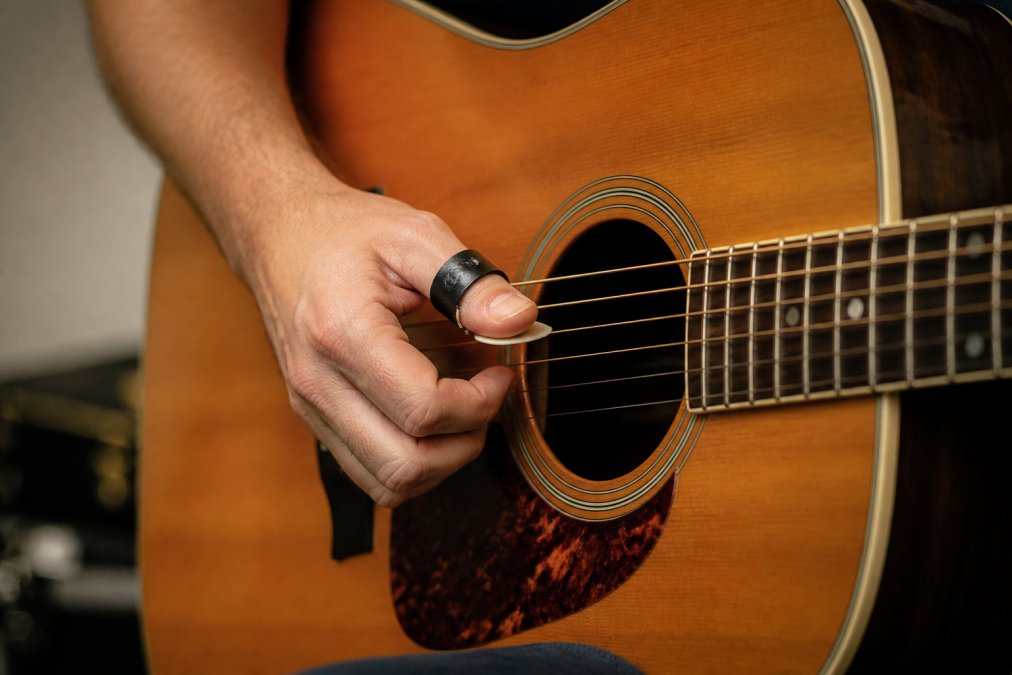
 how-to
Best Thumb Picks for Small Hands: Fit Guide
Table of Contents
- Why Standard Thumb Picks Fail Small Hands
- How to Measure Your Thumb for the Right Pick Size
- The Best Thumb Picks for Fingerstyle Guitarists with Small Hands
- How to Adjust Thumb Pick Fit for a Secure Grip
- Crossover Thumb Pick Benefits for Seamless Playing
- Reducing Hand Muscle Fatigue Guitar Players Feel
- Final Thoughts on Finding Your Perfect Fit
- Frequently Asked Questions
Last Updated: September 8, 2026
Why Standard Thumb Picks Fail Small Hands
Most thumb picks are designed around the average male hand. A standard pick has a fixed circumference and blade angle that assumes a certain thumb length and joint position, so when the fit is wrong, the pick slides, rotates, or digs into the knuckle, forcing you to grip harder just to keep it in place.
That death grip tenses the entire hand, slows articulation, and makes switching between fingerpicking and flatpicking feel clumsy. Many players conclude they cannot use a thumb pick when the real issue is they have never tried one sized for their hand.
Thumb picks for small hands need a shorter wrap, a tighter radius at the base, and often a shallower blade angle to keep the picking surface aligned with the fingertip. At Strum-N-Comfort, we have studied this fit problem closely because it is the single biggest reason players abandon thumb picks.
How to Measure Your Thumb for the Right Pick Size
The most reliable way to find a comfortable thumb pick for small hands is to measure the circumference of your thumb at its widest point, right at the base near the webbing. Wrap a flexible tape or string around that spot, mark where it overlaps, and lay it flat against a ruler.
A correctly fitting thumb pick should feel snug but never painful. You should be able to shake your hand without the pick flying off, yet rotate it slightly with gentle pressure. If you see gaps between the pick and your skin, or deep red marks after ten minutes of playing, the size is wrong.
A Visual Guide to Measuring Circumference
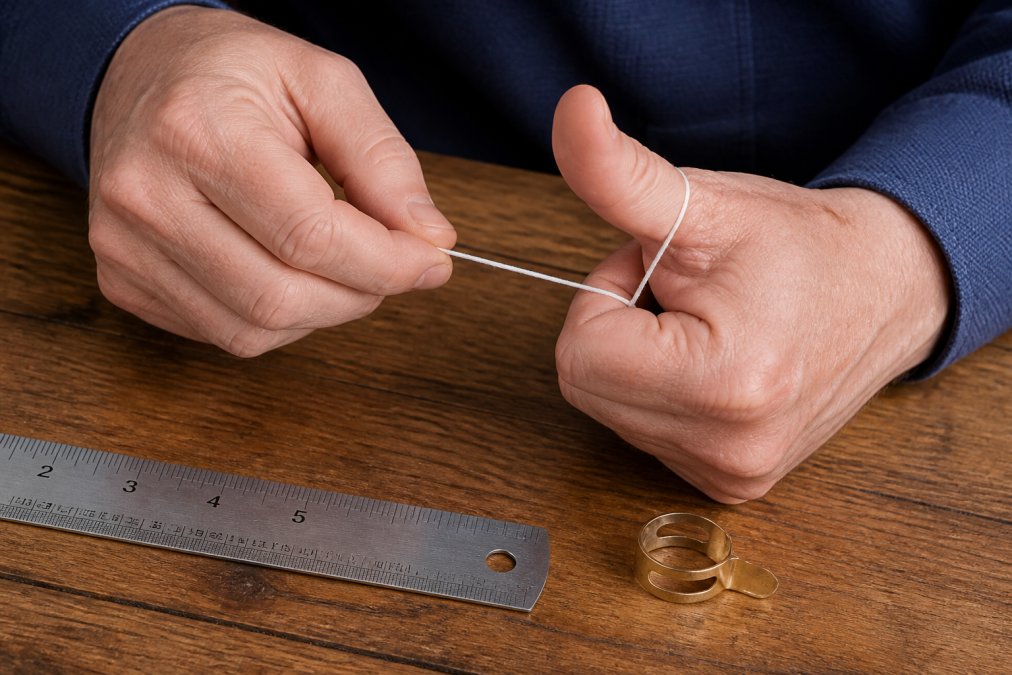
Here is the process broken down step by step:
- Hold your picking hand flat with the thumb relaxed and slightly extended.
- Wrap the string around the thumb at the base, just above the webbing.
- Pull it snug, but do not compress the skin.
- Mark the overlap point with a pen.
- Lay the string against a ruler and record the length.
- Compare your measurement to the sizing chart provided by the pick manufacturer.
This measurement matters more than any other factor. Picks labeled "small" vary significantly between brands, so relying on your exact circumference rather than a generic size label gives you a much better chance of a correct fit. If you fall between sizes, consider an adjustable thumb pick.
The Best Thumb Picks for Fingerstyle Guitarists with Small Hands
For fingerstyle guitarists with small hands, the ideal thumb pick balances a secure fit at the base of the thumb, a blade that reaches the strings without excessive wrist rotation, and enough flexibility for natural hand movement. A rigid pick that fits poorly will always lose to a flexible pick that fits well.
Pay attention to material and wrap design. Plastic picks offer flexibility and grip, while metal picks provide durability and a brighter attack, though metal can feel unforgiving against the knuckle during long sessions. The best thumb picks for fingerstyle guitarists disappear into the hand, letting you focus on tone and dynamics.
Material Breakdown: What You Are Actually Feeling
- Delrin and Acetal: These are the most common plastics in quality picks. They are stiff enough to transmit picking energy but have a slight, natural lubricity that reduces friction against the knuckle. For small hands, a Delrin pick that is too thick can feel like a cast; look for a thinner gauge (around 1.0mm to 1.2mm) to maintain flexibility.
- Celluloid: This is the classic material used in vintage-style picks. It is harder and brighter-sounding than Delrin but also more brittle. For players with small hands, celluloid's rigidity can be a problem because it does not conform well to a tight radius; it can create pressure points on the thumb joint.
- Nylon: Nylon picks are often more flexible and can be heat-molded at lower temperatures. They offer a warmer tone but can feel 'rubbery' against the string, which reduces attack precision. For small hands, nylon is forgiving on the joint but may require a slightly thicker blade to get the same volume as Delrin.
- Metal (Stainless Steel or Brass): Metal picks offer the brightest attack and the most durability. However, they have zero give. For a small hand, a metal pick must have a near-perfect anatomical fit from the start, as you cannot easily heat-mold it. The weight of metal can also cause the pick to rotate on a smaller thumb, making a textured inner surface essential.
The Fit-First Rule for Blade Shapes
A common mistake is choosing a pick based on blade shape alone. Teardrop and triangle blades each produce a different attack, but neither will sound good if the base does not fit. Solve the fit first, then experiment with blade shapes.
- Teardrop Blade: This is the most common shape. It offers a rounded attack that is forgiving for hybrid picking. For small hands, the issue is often that the blade is too long, extending past the fingertip and causing accidental string contact. Look for a 'short' or 'standard' blade length, not a 'long' one.
- Triangle Blade: This shape provides a sharper attack and is favored by players who want more articulation. The point of the triangle can be easier to control for players with smaller thumbs because it requires less rotation to hit the string cleanly. However, the sharper edge can be less forgiving if your hand is tense.
A Practical Comparison for Small Hands
Pick Feature | What It Does for Small Hands | Why It Matters for Fingerstyle |
|---|---|---|
Shorter wrap length | Reduces bulk against the thumb joint | Allows natural bending and faster articulation |
Flexible material (Delrin/Nylon) | Conforms to the thumb contour | Distributes pressure and reduces hot spots |
Adjustable fit | Fine-tunes tension without tools | Accommodates swelling and seasonal changes |
Shallow blade angle | Keeps the pick edge parallel to strings | Prevents scraping and unwanted pick noise |
Textured inner grip | Prevents rotation on a smaller thumb | Maintains consistent blade angle during aggressive picking |
The Crossover Advantage for Fingerstyle
For fingerstyle guitarists who also want to integrate flatpicking runs, the Crossover thumb pick category, which I named, offers a unique solution. Many standard thumb pick designs force you to put it down to grab a flatpick. A Crossover pick holds your own flatpick securely against the thumb, allowing you to switch between fingerstyle arpeggios and flatpicked lead lines without breaking your hand position. This is a technique enabler, allowing you to develop a Universal Picking Technique where the right hand moves as a single unit. For small hands, this eliminates the need to re-adjust your grip, where control is often lost.
When evaluating picks, look at how the pick integrates with your ability to hold a separate flatpick. The Strum-N-Comfort Custom Crossover thumb picks are designed with a flexible wrap that adapts to the player's anatomy, ensuring added functionality does not come at the cost of comfort.
How to Adjust Thumb Pick Fit for a Secure Grip
Even correctly sized thumb picks for small hands may need minor adjustments to feel truly locked in. The goal is a secure grip that does not require constant conscious correction. If you reposition the pick between every phrase, the fit is not working.
Start with the wrap. If the pick feels loose, gently squeeze the open sides together to reduce the circumference. Work slowly and test frequently, because plastic can crack if forced too fast. If it feels too tight, heating it slightly and stretching the opening provides immediate relief.
DIY Heat-Molding Techniques for a Custom Fit
Heat molding is the most effective way to customize a thumb pick for small hands. Use water heated to just below boiling, or a heat gun set to low. Warm the wrap portion for 15 to 30 seconds until pliable. Do not overheat it, as the plastic will deform permanently.
Once warm, place the pick on your thumb and press gently to mold the wrap to your contour. Hold it for 30 seconds while it cools. This removes pressure points against the knuckle and prevents rotation during aggressive picking.
For a non-heat alternative, some players add a thin strip of adhesive grip tape inside the wrap. This increases friction without changing the geometry, which can stop slipping during a live performance.
Crossover Thumb Pick Benefits for Seamless Playing
The most significant advancement in this space is the Crossover thumb pick, a category that combines the stability of a properly sized traditional thumb pick with the freedom to hold your own flatpick simultaneously. This allows guitarists to switch between fingerpicking and flatpicking without dropping or swapping equipment.
Strum-N-Comfort named the Crossover thumb pick category to solve exactly this problem. Our Custom Crossover thumb picks are comfortable, flexible, and highly effective in helping develop what we call a Universal Picking Technique. This approach trains your right hand to move fluidly between techniques within a single phrase.
The benefit for players with small hands is substantial. Because the Crossover pick holds your own flatpick securely against the thumb, you do not need to adjust your grip between techniques. This reduces hand muscle fatigue and lets you focus on the music. The SharkTooth and Kodiak models from Strum-N-Comfort fit all thumb sizes comfortably, with a flexible wrap that adapts to the player's anatomy.
Reducing Hand Muscle Fatigue Guitar Players Feel
Hand fatigue is often dismissed as a normal part of practicing, but it is frequently a sign of poor equipment ergonomics. When a thumb pick does not fit correctly, the muscles in your thumb and forefinger work overtime to stabilize it, leading to cramping, reduced speed, and sloppy articulation.
The Anatomy of the Problem: Why Your Hand Tires
The primary stabilizers of the thumb pick are the flexor pollicis brevis and the opponens pollicis, which control the thumb's opposition and grip. When a pick is too loose, these muscles fire continuously to keep it from rotating. When too tight, they fight the rigid material, creating a static contraction that restricts blood flow.
A secondary issue is the tendon of the extensor pollicis longus, which runs along the back of the thumb. A pick with a hard edge or a wrap that is too long can press on this tendon, causing friction and inflammation that radiates up the wrist. This is why a pick that feels fine for five minutes can become painful after thirty.
The Ergonomics of a Fatigue-Free Fit
A properly fitted thumb pick for small hands reduces strain by distributing pressure evenly across the thumb rather than concentrating it at the joint. The goal is a 'passive fit', where the pick stays on due to its geometry and the natural contour of your thumb, not muscular clamping force.
- Pressure Distribution: The wrap should contact the thumb along a broad surface, not just at the top and bottom edges. If you feel a 'pinch' at the webbing or the nail, the radius is too tight or too shallow.
- Joint Clearance: The wrap must end before the first knuckle (the interphalangeal joint). If it extends over the joint, it will act as a splint, preventing the natural flexion needed for relaxed playing.
- Blade Angle and Leverage: A blade that is angled too far forward forces you to lift your entire hand to clear the strings. This engages the larger muscles of the forearm (extensor digitorum) unnecessarily. A shallower angle allows you to use only the fine motor muscles of the thumb, which are far less prone to fatigue.
The Role of Flexibility in Endurance
Rigid picks transfer more picking energy but also more shock back into the thumb joint. Flexible picks absorb some of that shock, acting as a suspension system. For players with smaller hands, who often have less flesh as a natural cushion, this flexibility is critical. A pick that flexes with the thumb allows muscles to relax between strokes.
A Technique Check for Fatigue
Sometimes, fatigue is not the pick's fault. A common pattern is 'death grip', squeezing the pick with the thumb and index finger even when playing single-note lines. This is often a compensation for a pick that is too loose. Before assuming you need a stronger pick, check your grip:
- Play a simple arpeggio at a slow tempo.
- After each bar, consciously relax your thumb and index finger.
- If the pick rotates or slips when you relax, the fit is the problem.
- If the pick stays put, your grip tension is the problem.
The Crossover Solution for Sustained Play
For players who want to avoid fatigue while switching between techniques, the Crossover thumb pick category, which I named, offers a distinct ergonomic benefit. By holding a flatpick securely, it removes the need to excessively 'pinch' the pick between the thumb and index finger, eliminating the most common source of hand fatigue for hybrid players. The Strum-N-Comfort Custom Crossover thumb picks are comfortable and flexible, allowing you to develop a Universal Picking Technique without the added muscular load of managing two implements. This integrated approach maintains a more neutral, relaxed posture, the single most effective way to prevent fatigue.
Final Thoughts on Finding Your Perfect Fit
Finding the right thumb pick for small hands is a process of measurement, experimentation, and honest self-assessment. Start with your thumb circumference, choose a pick with a flexible wrap, and apply heat-molding techniques for a truly custom fit. The right pick should feel like an extension of your hand.
For guitarists who want to move seamlessly between fingerstyle and flatpicking, the Crossover thumb pick design from Strum-N-Comfort offers a practical path forward. Our comfortable, flexible picks support the development of a Universal Picking Technique, helping you improve speed, accuracy, and confidence without hand fatigue.
Frequently Asked Questions
How do I know what size thumb pick I need?
Measure the circumference of your thumb at its widest point, near the base and just above the knuckle. Use a flexible tape measure or a strip of paper and mark where it overlaps. Compare this measurement to the sizing chart provided by the manufacturer. Many players with smaller hands find that a medium size is still too loose and need a small or an adjustable option. The goal is a snug fit that doesn't pinch or slip.
What is the difference between a standard and a Crossover thumb pick?
A standard thumb pick has a blade that extends from the band to mimic a flatpick. A Crossover thumb pick is a new category, invented by Strum-N-Comfort, that features a unique design allowing you to hold your own flatpick or use the integrated blade. This makes switching between fingerstyle and flat-picking instant, without dropping your pick. The flexible, comfortable band fits all thumb sizes securely, supporting a Universal Picking Technique.
How can I make a thumb pick fit a small thumb?
First, try a pick designed for smaller hands, like a Crossover model with a flexible band. If your current pick is loose, you can carefully heat the band in warm water (around 150°F) for a few seconds to soften the plastic. Then, mold it tightly around your thumb, holding it until it cools. This DIY heat-molding technique creates a custom, secure fit. Avoid using boiling water, as it can damage the pick.
What are the best thumb picks for small hands?
For small hands, prioritize adjustable or flexible designs over rigid, one-size-fits-most plastic picks. Look for a pick with a comfortable, flexible band that conforms to your thumb's shape. The Strum-N-Comfort Crossover thumb picks are highly effective because their flexible design fits all thumb sizes comfortably. They are also excellent for developing a Universal Picking Technique, as they allow you to switch between fingerstyle and flat-picking without changing tools.