 ultimate-guide
Do Ergonomic Thumb Picks Really Work? A 2026 Guide
Photo Credit: Singer Songwriter and USA Veteran Scotty Hasting pictured above.
Table of Contents
- What Makes Ergonomic Thumb Picks Different
- Why Do My Hands Hurt Playing Guitar? The Fatigue Problem
- How Ergonomic Thumb Picks Reduce Hand Fatigue
- The Universal Picking Technique: Combining Fingerstyle and Flat Picking
- Ergonomic Thumb Picks and Tone: Attack, Dynamics, and Articulation
- Fit, Comfort, and Sizing: Finding the Right Ergonomic Thumb Pick
- How Long Does It Take to Adjust to Ergonomic Thumb Picks?
- Frequently Asked Questions
Last Updated: September 11, 2026
What Makes Ergonomic Thumb Picks Different
Ergonomic thumb picks are reshaped around the anatomy of the human thumb rather than a flat piece of plastic. That changes how the pick sits, how much grip pressure you need, and how freely your remaining fingers move. At Strum-N-Comfort, we developed an entire category around that idea: Crossover thumb picks, designed to sit comfortably, flex with your thumb, and help players develop what we call a Universal Picking Technique.
If you have wondered whether do ergonomic thumb picks really work, they work when the design solves a real mechanical problem. A traditional pick wraps your thumb in a rigid loop and forces one hand position. An ergonomic pick spreads contact across the pad and side of the thumb, reducing the grip pressure needed to hold it.
The Anatomy the Design Has to Respect
Your thumb is not a cylinder. It has a wide pad, a narrower dorsal side, an interphalangeal joint roughly two-thirds of the way up, and a base that tapers toward the wrist. A traditional coiled band treats all of that as a uniform tube, so it either pinches the pad or slides off the taper.
Ergonomic designs work because they map to three anatomical realities:
- The pad is the load-bearing surface. Spreading contact across the pad rather than concentrating it on one edge is what eliminates the red pressure mark players get from coiled bands.
- The joint has to articulate. A band that crosses the interphalangeal joint without a relief or flex zone binds every time you bend the thumb, which is constant in fingerstyle playing.
- The base tapers. A band that grips the base as firmly as the tip will always feel either loose at the tip or tight at the base. Ergonomic shapes account for the taper instead of fighting it.
Traditional vs. Ergonomic Design: Key Differences
A traditional thumb pick is a coiled band with a blade, sized in fixed increments, so a player with a narrow thumb clamps down to stay secure. That constant clamping is where fatigue starts.
Ergonomic designs change three things:
- Contact area. The band spreads pressure across a wider surface instead of digging into one spot.
- Blade angle. The picking edge sits closer to the natural angle of your thumb, so your wrist does not have to compensate.
- Flex. The material gives slightly under load rather than resisting your thumb's movement.
That last point matters more than most players expect. A pick that flexes lets you keep a light grip without dropping it, and a light grip is the foundation of speed.
Why 'Ergonomic' Is Not Just Marketing
The word gets used loosely, so here is a practical test. An ergonomic thumb pick should pass all four:
- It stays seated through aggressive downstrokes and upstrokes without you increasing grip pressure.
- It leaves no pressure point on the pad or the side of the thumb after a full practice session.
- Your thumb can flex at the joint without the band binding or rotating.
- The blade meets the string at an angle your hand already wants to make, not one you have to force.
Fail any of those and the 'ergonomic' label is decorative. Pass all four and the design is doing real mechanical work, the difference you feel within a single session.
Our Crossover thumb picks are comfortable, flexible, and highly effective in helping develop a Universal Picking Technique, and the reason is mechanical, not cosmetic.
Why Do My Hands Hurt Playing Guitar? The Fatigue Problem
Hand pain during playing usually comes from sustained tension, not one bad movement. Your picking hand holds a grip for an entire set, and any grip requiring constant muscular effort eventually produces soreness in the thumb, the thenar muscles, and sometimes the forearm.
The American Society for Surgery of the Hand notes that repetitive gripping tasks are a common source of hand and wrist strain, and musicians are a textbook case. If you want to understand repetitive strain guidance from the American Society for Surgery of the Hand, the pattern is consistent: sustained static load plus repetition equals discomfort.
How Grip Pressure and Tension Build Up
Grip pressure compounds. A loose pick forces you to squeeze, squeezing recruits more muscle than necessary, and that tension travels up the forearm and changes your angle of attack without you noticing.
How Ergonomic Thumb Picks Reduce Hand Fatigue
Ergonomic thumb picks reduce hand fatigue by lowering the grip pressure required to keep the pick stable. When the band conforms to your thumb and flexes with movement, your hand stops fighting the pick and starts playing with it.
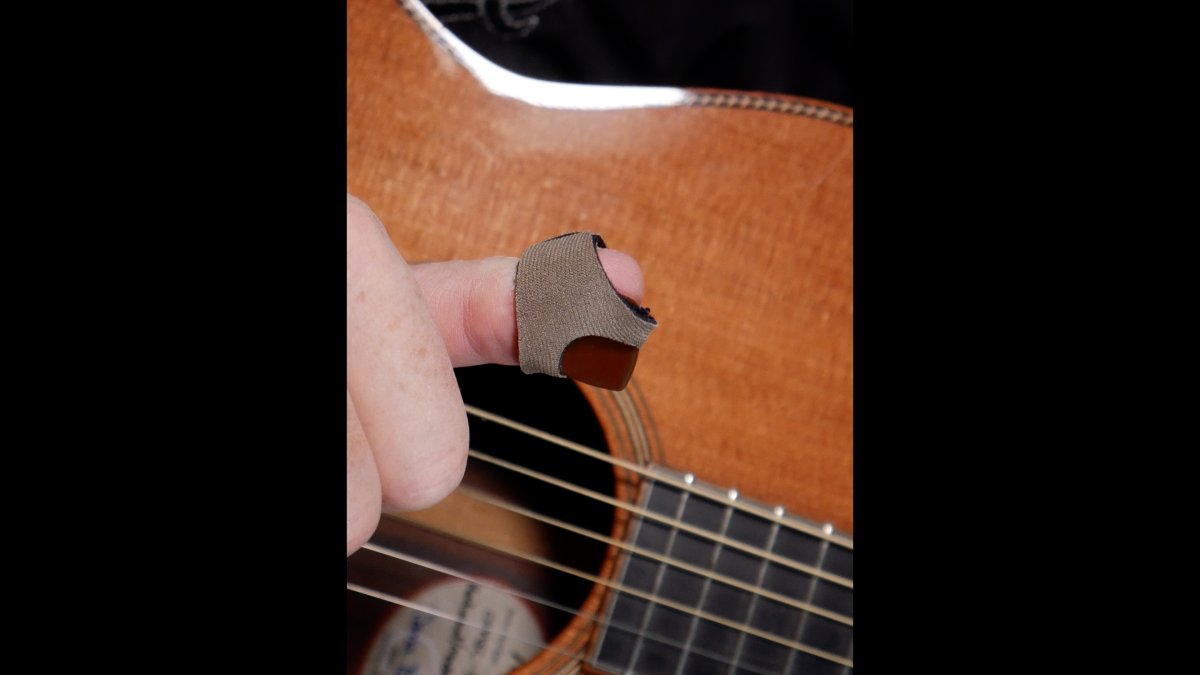
That is the whole mechanism, and why fit matters so much. A rigid pick that fits poorly creates a pressure point; a flexible pick that fits well spreads the load and lets your thumb relax between notes. David Oakes, a former Musicians Institute instructor and USC professor, said after testing ours: "After just a few hours of play, I can truly say that this SharkTooth Pick produces less muscle fatigue."
Our Crossover thumb picks are comfortable, flexible, and highly effective in helping develop a Universal Picking Technique, and the fatigue reduction is the reason players notice the difference within a single session.
The Universal Picking Technique: Combining Fingerstyle and Flat Picking
Universal Picking Technique is the ability to move between fingerstyle patterns and flat-pick attack without changing hand position or swapping gear.
The obstacle has always been mechanical. A flat pick lives between thumb and index finger; fingerstyle needs the thumb free to walk a bass line. Most players tuck a flat pick in their palm, which works until it does not.
It should be noted that there is an advanced technique called Hybrid Picking where the player holds a flat pick between the thumb and first finger while finger picking with the middle, ring and even picky finger. However, with Hybrid Picking, the player looses the use of the first finger.
Buy Now at our secure ETSY SHOP music store →
Seamless Transitions Between Fingerstyle and Flat Picking
A Crossover thumb pick keeps a picking surface on your thumb at all times, so the transition becomes a change in hand angle rather than equipment. Gil Parris, an RCA/BMG recording artist and guitarist for Blood, Sweat & Tears, called it "definitely an improvement over conventional thumb picks for easily moving between fingerstyle and flat pick techniques."
That is the practical test. If you can play a Travis-style thumb-lead pattern and then dig into a flat-picked line without a pause, the pick is doing its job.
Technique Goal | Traditional Thumb Pick | Ergonomic Crossover Pick |
|---|---|---|
Fingerstyle bass lines | Works, but thumb stays clamped | Works with relaxed thumb |
Flat-pick attack | Requires palm-tucking a flat pick | Built into the thumb position |
Switching mid-song | Awkward, timing risk | Angle change only |
Extended sets | Fatigue builds in the thumb | Reduced grip pressure |
Hybrid picking | Possible with practice | Natural finger access |
Ergonomic Thumb Picks and Tone: Attack, Dynamics, and Articulation
Tone changes when your grip changes. A tight grip produces a stiff, bright attack with less dynamic range because the pick cannot flex against the string. A relaxed grip lets the pick give slightly on contact, softening the transient and adding warmth.
Players chasing treble often tighten up, which is backwards. Brightness comes from pick gauge, pick angle and material, not squeezing harder. Celluloid and similar materials sound warmer and rounder; harder plastics push more treble and projection. Gauge does the rest: thinner picks flex and soften attack, heavier picks transfer more energy for volume and articulation.
Nobody tells you your thumb is a poor shock absorber. Every bit of grip tension shows up in the attack. Relax the grip and your dynamics open up, because you can vary how hard the pick hits the string instead of holding one volume.
Fit, Comfort, and Sizing: Finding the Right Ergonomic Thumb Pick
Fit decides whether an ergonomic pick helps you or sits in a drawer. A proper fit stays put with minimal grip pressure, leaves no red pressure mark after 30 minutes, and lets your thumb bend at the joint without the pick digging in.
Use this checklist before committing to any thumb pick:
- The pick stays on through a full downstroke and upstroke without you squeezing
- You can feel the string through the pick, not just the band
- No pressure point on the side of the thumb after 30 minutes
- Your thumb can flex at the joint without the band binding
- The blade angle matches your natural hand position, not the other way around
Small hands are the most common concern, and a fair one. Our Crossover thumb picks are designed to fit all thumb sizes, because a pick sized for an average-to-large thumb will never sit correctly on a smaller hand. Coming from a fixed-size traditional pick, sizing is the first thing you will notice.
How Long Does It Take to Adjust to Ergonomic Thumb Picks?
Most players adjust within a few hours, with the first session feeling unfamiliar and the second feeling normal. The adjustment is not learning a new technique; it is unlearning the extra grip pressure you have been carrying. Here is a realistic schedule to follow.
A Four-Week Transition Schedule
The goal is to build a relaxed-grip habit while keeping your right-hand skills intact. Practice in short blocks and stop before tension sets in.
- Days 1-3 (15-20 minutes per session). Play only slow fingerstyle patterns, Travis-style thumb-lead figures work well. Do not attempt flat-picked lines yet. The only goal is to notice when you are over-gripping and release it.
- Days 4-7 (20-30 minutes). Add simple alternating bass patterns and let the thumb move independently of the fingers. If the pick rotates or slides, stop and reset rather than squeezing harder.
- Week 2 (30 minutes). Introduce flat-picked single-note lines at a slow metronome tempo. Alternate one bar of fingerstyle with one bar of flat picking so the transition becomes a change in hand angle, not a change in equipment.
- Week 3. Add hybrid picking, thumb plus one or two fingers on adjacent strings. This is where the freedom of a relaxed thumb pays off most.
- Week 4 and beyond. Push tempo in small increments (about four beats per minute at a time) only after three consecutive clean passes. Attack, dynamics, and articulation settle into a consistent sound around this point.
Milestones to Expect Along the Way
- First 30 minutes: The pick feels different, and you may over-grip out of habit. This is normal.
- First few hours: Grip pressure drops, and fingerstyle patterns start to feel natural again.
- First week: Transitions between fingerstyle and flat picking stop requiring conscious thought.
- Ongoing: Attack, dynamics, and articulation settle into a consistent sound.
Troubleshooting the Common Sticking Points
- The pick rotates during play. Usually a sign you are squeezing to compensate for a fit issue, not a technique issue. Re-check the fit before adding practice time.
- Your thumb gets sore at the joint. The band is likely binding where your thumb flexes. A pick with a proper flex zone should not do this.
- Flat-picked lines feel weak. You are probably still holding the pick at a fingerstyle angle. Let the wrist rotate slightly rather than forcing the thumb.
- You keep reaching for a flat pick. This fades fastest if you resist the urge for the first two weeks. The whole point of a Crossover thumb pick is that you do not need to swap gear.
Charles Underwood, a former Sun Records A&R director and sound engineer for Elvis Presley, summed up the result: "Promotes increased speed, accuracy and player confidence. The SharkTooth Crossover Pick is an innovative product."
If you want to see how the design behaves in real playing rather than in a description, player demonstrations and product details from Strum-N-Comfort show the Crossover thumb picks in use across fingerstyle and flat-picking passages.
Our Crossover thumb picks are comfortable, flexible, and highly effective in helping develop a Universal Picking Technique, and a structured transition is the fastest way to feel that difference.
Frequently Asked Questions
Do ergonomic thumb picks actually reduce hand fatigue?
Yes. Ergonomic thumb picks are designed to distribute pressure more evenly across the thumb, reducing the grip tension that causes fatigue during long practice or performance sessions. David Oakes, former Musicians Institute instructor, noted that after just a few hours of play, the SharkTooth Pick produced less muscle fatigue. The key is the fit: a pick that conforms to your thumb's natural shape requires less force to hold, so your hand stays relaxed longer.
What is a Crossover thumb pick?
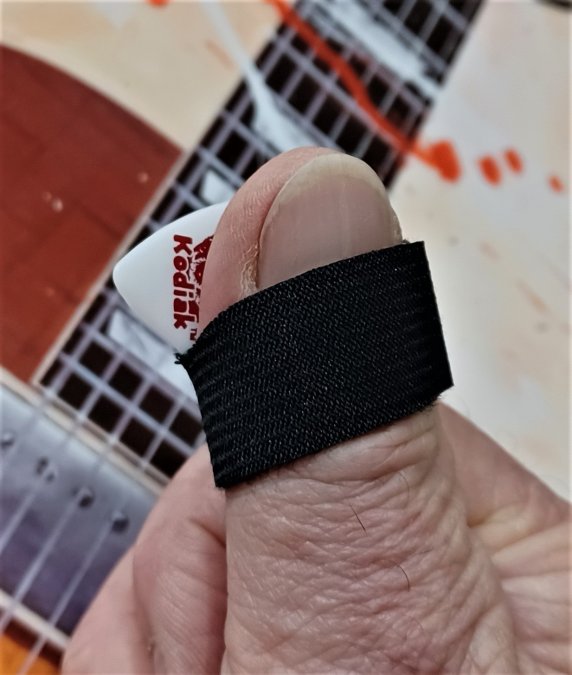
A Crossover thumb pick is a new category of thumb pick invented by Strum-N-Comfort. It is designed to let you switch seamlessly between fingerstyle and flat-picking techniques without changing picks or adjusting your hand position. The Crossover design is comfortable, flexible, and highly effective in helping develop a Universal Picking Technique. Models like the SharkTooth and Kodiak are built to fit all thumb sizes and work with your own flat picks.
Can ergonomic thumb picks help with fingerstyle and flat-picking transitions?
Absolutely. The main advantage of ergonomic thumb picks, especially Crossover models, is that they allow you to move between fingerstyle and flat-picking without fumbling. Gil Parris, recording artist and guitarist for Blood, Sweat & Tears, said the SharkTooth is definitely an improvement over conventional thumb picks for easily moving between fingerstyle and flat pick techniques. This makes them ideal for players who need both techniques in the same song.
Are ergonomic thumb picks suitable for beginners?
Yes, beginners can benefit from ergonomic thumb picks because they encourage proper hand position and reduce the chance of developing bad habits like excessive grip pressure. The comfortable, flexible design helps new players focus on technique rather than fighting their pick. Starting with an ergonomic pick can also make the transition to fingerstyle and flat picking smoother as skills develop.