 ultimate-guide
Improving Fingerstyle Technique for Live Sets: 2026 Guide
Table of Contents
- Why Fingerstyle Technique Falls Apart on Stage
- Warm-Up Routine for Fingerstyle Technique Before a Live Set
- How to Transition Between Fingerstyle and Flat-Picking Mid-Song
- Reducing Hand Fatigue While Playing Guitar Through Long Sets
- Developing a Universal Picking Technique for Any Playing Situation
- Building Mental Preparation and Managing Performance Anxiety
- Setlist Construction and Live Performance Logistics for Fingerstyle
- Conclusion
- Frequently Asked Questions
Last Updated: September 22, 2026
Why Fingerstyle Technique Falls Apart on Stage
Your fingers work fine in the practice room. Put a room full of people in front of you, and suddenly your thumb forgets its job. This is the central problem with improving fingerstyle technique for live sets: the skills don't disappear, but the conditions change. Adrenaline tightens your grip, stage monitors change what you hear, and your hands get cold between songs.
Warm-Up Routine for Fingerstyle Technique Before a Live Set
The best pre-show warm-up takes five minutes and targets the picking hand specifically, not the whole body of repertoire. Most players run through songs, which rehearses memory instead of technique. A proper warm-up wakes up thumb independence, finger coordination, and string tension awareness before you walk on.
Five-Minute Pre-Show Warm-Up
- Minute 1: Open-string thumb rolls, alternating thumb and index at a slow tempo with a metronome
- Minute 2: Simple arpeggios across three strings, focusing on even volume between thumb and fingers
- Minute 3: Bass line plus melody on two strings, keeping the thumb steady while fingers move
- Minute 4: Light chord shapes with single-note melody notes on top
- Minute 5: One full run of your opening song at 80% tempo
Keep your fretting hand relaxed during all five minutes. The goal is economy of motion, not speed.
How to Transition Between Fingerstyle and Flat-Picking Mid-Song
Smooth switching between fingerstyle and flat-picking comes down to where your pick lives when you're not using it. Players who tuck a pick into their palm or wedge it between fingers lose time and accuracy on the switch. The fix is a consistent, repeatable hand position that keeps the pick accessible without disrupting your fingerstyle patterns.
The Drop-Pick Problem and How to Solve It
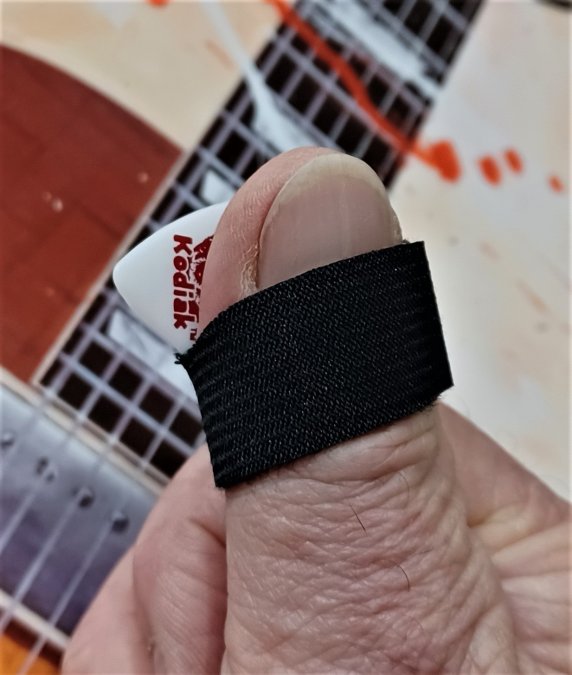
A thumb pick with an adjustable strap removes the tuck-and-grab problem entirely, because the pick stays on your thumb whether you're plucking or strumming.
Reducing Hand Fatigue While Playing Guitar Through Long Sets
Hand fatigue during long sets comes from grip tension, not from playing itself. Players who squeeze the pick or press strings harder than needed burn through their hand strength in the first thirty minutes. Reducing hand fatigue while playing guitar starts with loosening your grip and letting the pick do more of the work.

Developing a Universal Picking Technique for Any Playing Situation
A universal picking technique is a single right-hand approach that lets you move between fingerstyle patterns, flat-picking, and hybrid playing without changing your hand position. Instead of maintaining three separate techniques, you build one foundation and adjust the tools around it.
Playing Situation | Right-Hand Demand | What Helps Most |
|---|---|---|
Solo fingerstyle | Thumb independence, bass separation | Loose thumb wrap, light grip |
Strummed sections | Pick control, even attack | Pick secured on thumb |
Hybrid picking | Fast switching, no tuck time | Flat pick held in strap system |
Long sets | Reduced grip tension | Adjustable strap fit |
Building Mental Preparation and Managing Performance Anxiety
Performance anxiety shows up in the picking hand first. Your breathing shortens, your grip tightens, and your thumb starts rushing the bass line. Managing it is a skill you rehearse, not a personality trait you either have or don't.
Visualization That Actually Transfers to the Stage
Generic "picture yourself playing well" advice doesn't hold up under stage lights. What works is specific, sensory rehearsal of the right hand:
- Rehearse the first eight bars, not the whole song. Visualize your thumb hitting the first bass note, the exact string, the exact finger. Repeat until the opening is automatic.
- Rehearse the transitions. Picture the moment you switch from fingerstyle to flat-picking, where your hand is, and how the pick meets the string.
- Rehearse the recovery, not just the success. Picture yourself missing a bass note and continuing without stopping. Players who only visualize flawless runs panic the first time something slips.
- Rehearse the room. Picture the monitor position, the lighting angle on your picking hand, and where you're standing. Unfamiliar conditions are a bigger anxiety trigger than unfamiliar music.
Handling Mistakes Without Losing the Set
The single most useful live skill is continuing after a wrong note. A missed bass note is not a performance failure; stopping to fix it is. A common pattern among experienced fingerstyle performers is a three-step recovery:
- Keep the thumb moving. The bass line is the pulse. If the thumb keeps its pattern, the audience often doesn't register the mistake.
- Drop the next ornament, not the next beat. Skip the fill, keep the groove.
- Re-enter on the next downbeat. Don't try to catch up mid-phrase; rejoin at a natural landing point.
A Pre-Show Reset That Fits in Two Minutes
Before a set, run a short sequence: slow breathing for 30 seconds, one slow arpeggio to check thumb and finger balance, and a mental walk-through of your first three songs. Fretboard visualization offstage builds the same calm onstage.
Buy Now at our secure ETSY SHOP music store →
Setlist Construction and Live Performance Logistics for Fingerstyle
Setlist order affects your hands as much as your audience. Opening with your most technically demanding fingerstyle piece is a common mistake, because your picking hand hasn't warmed into the room yet. A working pattern many solo fingerstyle players use for a 45- to 60-minute set is to sequence by right-hand demand rather than by mood:
- Songs 1-2: Groove-first, low right-hand demand. Thumb-driven patterns, open chords, minimal independent melody. This is your onstage warm-up.
- Songs 3-5: Your hardest material. Hand is warm, adrenaline has settled, and attention is still high.
- Songs 6-8: Mid-demand pieces, including any hybrid-picking or flat-pick transitions. Plan these here, not at the end.
- Songs 9-10: Closers that feel good to play. Fatigue is real by this point; end on material your hand can execute cleanly when tired.
Stage Logistics That Change How Your Right Hand Works
- Monitor level: Ask for your guitar in the monitor before the first song, not during it. If you can't hear your thumb, you'll play harder than you need to, and grip tension climbs within the first few songs.
- Standing vs. sitting: Standing shifts the guitar angle and raises your right shoulder. If you rehearse seated and perform standing, your picking-hand geometry changes on stage. Rehearse in the position you'll perform in.
- Strap height: A strap that's too low tilts the soundboard away from your picking hand and forces your wrist into a bend. Keep the wrist neutral and the strings at a consistent angle.
- Spare pick placement: Keep a spare thumb pick on your mic stand or in a pocket you can reach without looking. A dropped pick mid-set is a logistics problem, not a technique problem.
- Cold hands between songs: Hands cool down during talk breaks and tuning. A 20-second open-string thumb roll before the next song keeps the picking hand ready.
A thumb pick that stays on your thumb through the whole set removes one variable from this planning. Crossover thumb picks are comfortable, flexible, and highly effective at helping players develop a Universal Picking Technique, so the right-hand approach you rehearse is the one you bring on stage.
Conclusion
Live performance exposes every weak point in your picking hand, which is exactly why it's the best place to test your technique. Strum-N-Comfort builds Crossover thumb picks around that reality: comfortable, flexible, and highly effective at helping players develop a Universal Picking Technique. Both the SharkTooth and Kodiak models feature a fully adjustable thumb strap system, and the SharkTooth models let you use your favorite flat pick with the strap system.
Frequently Asked Questions
How can I improve my fingerstyle technique for live performance?
Build a pre-show warm-up routine that includes arpeggios, scales, and the specific fingerstyle patterns in your setlist. Practice under performance conditions: standing up, with a metronome, and without stopping for mistakes. Focus on economy of motion and consistent dynamic control. Recording your practice sessions reveals tension you might not feel in the moment. Repetition builds the muscle memory that holds up when nerves spike.
Why is fingerstyle guitar harder to play in front of an audience?
Performance anxiety tightens muscles in your picking hand, which reduces finger independence and makes your fingerstyle patterns feel foreign. The subconscious mind defaults to whatever you have practiced most, so if you have only practiced sitting down in a quiet room, that is what your hands expect. Simulating stage conditions during practice, including standing and playing through distractions, closes that gap.
How do I transition between fingerstyle and flat-picking during a set?
The most reliable method is using a thumb pick system that holds your flat pick securely when you switch to fingerstyle. A Crossover thumb pick with an adjustable strap lets you keep your favorite flat pick attached and ready. Practice the transition until it takes less than a second. Start with slow tempo songs where you alternate techniques every few bars, then increase speed as the motion becomes automatic.
What are the most common fingerpicking mistakes during live sets?
The biggest mistakes are gripping too hard when nerves kick in, losing thumb independence when bass lines need to stay steady, and neglecting nail maintenance before a show. Players also rush tempo during difficult passages. Another common error is practicing only the hard parts instead of playing full songs start to finish, which means you never build the stamina or mental map for complete performances.
How do I maintain consistent volume and tone while fingerpicking live?
Consistent tone starts with consistent attack. Practice at the same dynamic level you plan to use on stage, and use a metronome to keep rhythm steady. Thumb independence is critical: your thumb should maintain bass line volume even when melody notes get busy. Check your nail length and filing before every show. A thumb pick with a comfortable, flexible strap keeps your picking hand relaxed, which translates to even dynamic control.
What is a universal picking technique and why does it matter for live sets?
A universal picking technique means your right hand can move between fingerstyle, flat-picking, and hybrid picking without fumbling for a pick or changing hand position. This matters on stage because songs often require multiple techniques, and every second spent searching for a dropped pick breaks your connection with the audience. A Crossover thumb pick with a fully adjustable strap system helps develop this by keeping your flat pick secure and accessible.
How can I reduce hand fatigue during long practice sessions and shows?
Start by loosening your grip. Tension in the thumb and wrist accelerates fatigue faster than anything else. Take short breaks every 20 to 30 minutes during practice. Use an ergonomic thumb pick with a flexible strap that distributes pressure evenly across your thumb rather than concentrating it at one point. Stretching your fingers and wrists before and after playing also helps. If fatigue persists, check your posture and strap height.
Should I change my setlist to account for fingerstyle demands?
Yes. Place your most technically demanding fingerstyle pieces early in the set when your hands are fresh. Follow them with songs that use flat-picking or simpler strumming to give your fingers recovery time. Avoid stacking three or four fingerstyle-intensive songs back to back. Also consider tuning changes: if you use alternate tunings, group those songs together to minimize between-song adjustments and keep your stage presence focused on the music.