
 ultimate-guide
Mastering Hybrid Picking with Thumb Picks 2026
Table of Contents
- What Hybrid Picking Actually Is (and Why Thumb Picks Enable It)
- How to Hold a Guitar Pick Securely for Hybrid Playing
- Crossover Thumb Picks: A New Category Built for Hybrid Players
- Hybrid Picking Exercises for Beginners
- Reducing Hand Fatigue While Guitar Playing
- Genre Applications: Where Hybrid Picking Shines in 2026
- Building a Step-by-Step Practice Routine
- Common Mistakes and How to Avoid Them
- Frequently Asked Questions
Last Updated: September 17, 2026
What Hybrid Picking Actually Is (and Why Thumb Picks Enable It)
Hybrid picking is a right-hand technique that combines a flat pick held between the thumb and index finger with the middle, ring, and pinky fingers plucking strings directly. This guide from Strum-N-Comfort breaks down how to build that skill.
How to Hold a Guitar Pick Securely for Hybrid Playing
Learning how to hold a guitar pick securely is the foundation everything else rests on.
The Standard Flat Pick Grip
Hold the flat pick between your thumb and the side of your index finger, leaving roughly a quarter inch of tip exposed. Grip firm enough that the pick will not rotate, loose enough that your hand does not cramp. Most players choke up too far, expose more tip than feels comfortable at first for downstroke and upstroke control.
Adjusting Your Anchor Point for Hybrid Work
Your anchor point is where the heel of your hand rests near the bridge. For hybrid playing, shift it slightly toward the bass side so your middle and ring fingers reach the treble strings without lifting your whole hand. Players coming from strict alternate picking find this awkward for the first week, your hand will drift back to its old spot, so correct it deliberately for a few sessions.
Crossover Thumb Picks: A New Category Built for Hybrid Players
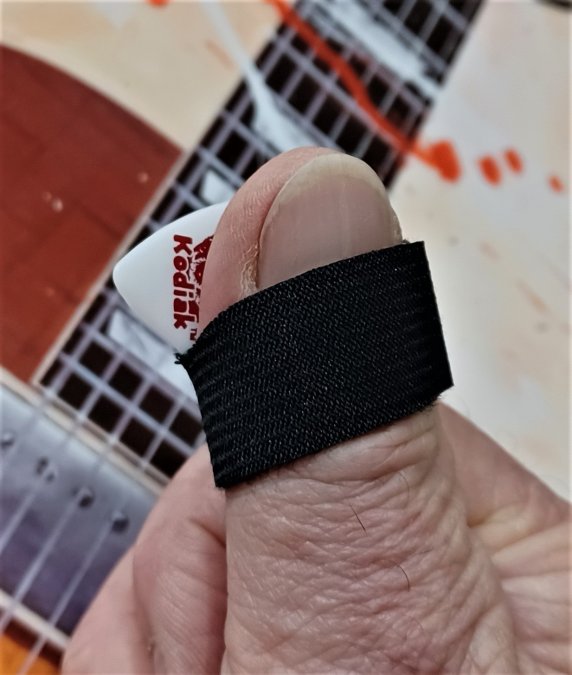
Players with smaller hands often worry these systems will not fit. The adjustable strap solves that, since it tightens down rather than relying on a fixed molded size.
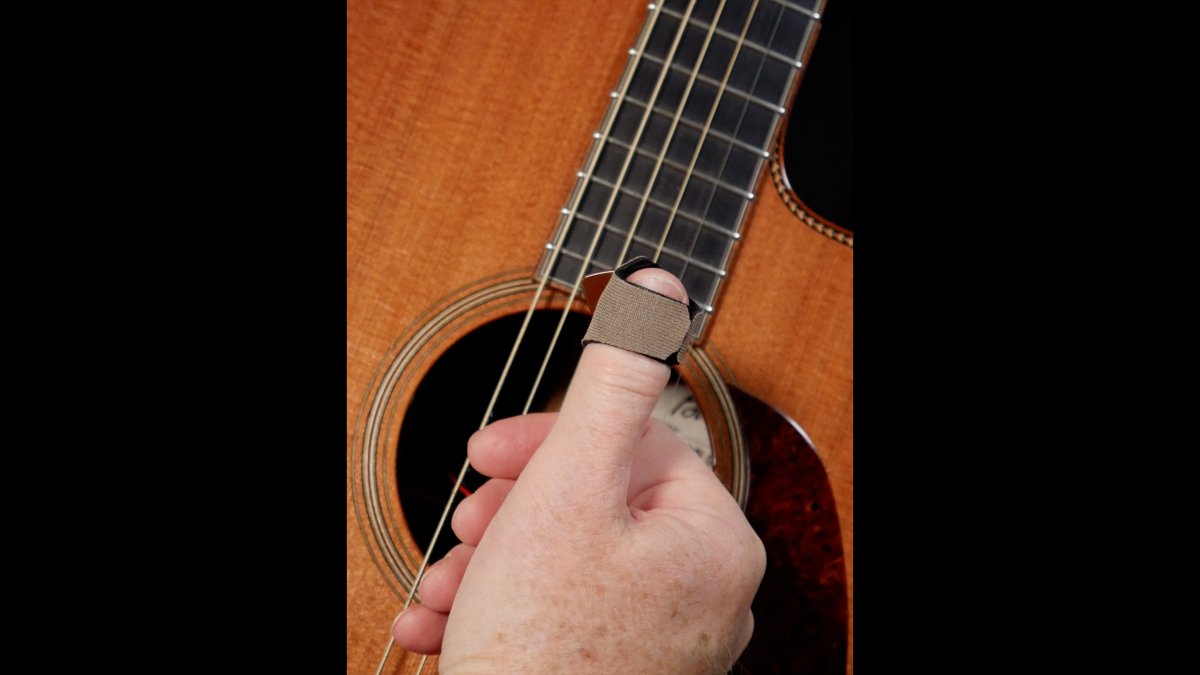
Guitarist using a Crossover thumb pick and flat pick for hybrid picking on acoustic guitar strings
Hybrid Picking Exercises for Beginners
Start slow, use a metronome, and resist speeding up before the motion is clean. These exercises are a progression: each assumes you can play the previous one evenly at a slow tempo. A useful benchmark: most players play Exercise 1 cleanly at 60 BPM within a week, Exercise 2 at 60 BPM within two to three weeks, and Exercise 3 at 50-60 BPM within a month.
Exercise 1: Alternating Flat Pick and Middle Finger
Play a downstroke with the flat pick on the low E string, then pluck the G string with your middle finger. Repeat on each beat, keeping your ring and pinky fingers relaxed and curled. Do this for two minutes at a slow tempo; the goal is even volume between pick and finger, which is harder than it sounds, the finger note is usually quieter.
Exercise 2: Three-Finger Cascade
Now add the ring finger. Flat pick on the A string, middle finger on the D string, ring finger on the G string, then reverse. This builds the finger independence that string skipping and cross-picking depend on.
Exercise 3: String Skipping with the Middle Finger
This drill separates players who can actually use hybrid picking in real music from players who can only run cascades. Play a flat-pick downstroke on the low E string, then pluck the high E string with your middle finger, it has to jump over four strings. Then reverse.
Exercise 4: Finger Independence Isolation
Hold a chord shape with your fretting hand and pluck each string with a different right-hand finger: flat pick on the low E, middle on the A, ring on the D, pinky on the G. Then reverse.
Exercise 5: Cross-Picking Pattern
Play a three-note pattern alternating pick and fingers across non-adjacent strings: flat pick on the low E, middle finger on the G, ring finger on the B, then back down. This is the foundation of country cross-picking and shows up constantly in modern worship and indie guitar parts.
How to Structure Practice Time
Do not run all five exercises in one session. A workable split is:
- Weeks 1-2: Exercise 1 and Exercise 2 only, 10 minutes total per day.
- Weeks 3-4: Add Exercise 3, keep the total under 15 minutes.
- Weeks 5-6: Add Exercise 4 and Exercise 5, 20 minutes total.
Reducing Hand Fatigue While Guitar Playing
Reducing hand fatigue while guitar playing comes down to three things: grip pressure, pick ergonomics, and practice breaks.
Fatigue Cause | Fix | What It Affects |
|---|---|---|
Over-gripping the pick | Loosen grip, check every few minutes | Forearm and thumb |
Fixed thumb pick angle | Switch to an adjustable strap design | Thumb joint and wrist |
No practice breaks | Play in 20-minute blocks with rest | Whole hand |
Wrist bent too far | Adjust anchor point and strap tension | Wrist and tendons |
Genre Applications: Where Hybrid Picking Shines in 2026
Most hybrid picking guides treat the technique as genre-neutral. That is a mistake: the way you use pick and fingers changes dramatically by style, and country patterns sound wrong in jazz.
Country and Chicken Pickin'
Country is the most obvious home for hybrid picking, and the most demanding. The signature move is snapping a bass note with the flat pick while popping a treble note with the middle or ring finger, often on the same beat. A common pattern is the "boom-chick" figure: flat pick on the low root note, middle finger on the fifth string, ring finger on a double-stop two frets up.
Buy Now at our secure ETSY SHOP music store →
Jazz
Jazz hybrid picking is quieter and more legato than country. The pick handles the attack note of a line; the fingers handle the rest, often softer. This is where a thumb pick that sits at the right angle matters most, because jazz lines require the thumb to move independently of the fingers holding the flat pick.
Modern Worship
Worship music leans on wide, ringing chord voicings that pure strumming muddies. Hybrid picking lets you articulate the bass note with the pick while the upper voices ring from the fingers, giving the chord both definition and space.
Blues
Blues hybrid picking opens up double-stop lines that would be awkward with a pick alone. The pick handles the lower note; the middle finger grabs the upper. This is the foundation of a lot of Texas and jump blues phrasing. A useful drill is to play a slow shuffle and alternate pick and finger on each pair of strings, aiming to make the two attacks sound like one voice, not two.
Rock and Progressive
In rock and progressive playing, hybrid picking enables sweep picking and string skipping patterns that need both pick attack and finger articulation. The pick carries the downstroke sweep; the fingers catch the notes the pick cannot reach without a position shift.
Where Hybrid Picking Does Not Belong
A Note on Genre Switching
If you play more than one of these styles, practice them in separate sessions. Country chicken pickin' posture differs from jazz legato posture, and switching mid-practice blurs both. Give each genre its own block until the postures are automatic.
Building a Step-by-Step Practice Routine
A workable routine is short and repeatable. Twenty focused minutes beats an hour of unfocused noodling.
- Warm up (3 minutes): Chromatic runs with alternate picking, no hybrid work yet.
- Grip check (1 minute): Confirm your flat pick grip and strap tension before playing anything.
- Exercise 1 (4 minutes): Alternating flat pick and middle finger at a slow tempo.
- Exercise 2 (4 minutes): Three-finger cascade, both directions.
- Apply it (5 minutes): Play a song or lick you already know, but force hybrid picking into it.
- Cool down (3 minutes): Slow, relaxed fingerstyle patterns to release tension.
Common Mistakes and How to Avoid Them
The biggest mistake is treating the thumb pick and flat pick as separate systems. They share one hand and have to cooperate.
Frequently Asked Questions
What is the advantage of using a Crossover thumb pick for hybrid picking?
Crossover thumb picks let you switch between flat-pick and fingerstyle playing without changing your grip. The adjustable strap system keeps the pick secure on your thumb while freeing your index, middle, and ring fingers for plucking. This means you can play a bass note with the pick and simultaneously grab higher strings with your fingers, which is the core of hybrid picking. The comfort and flexibility of the design help you develop what Strum-N-Comfort calls a Universal Picking Technique.
How do I transition between flat-picking and fingerstyle using a thumb pick?
Start by holding the thumb pick as you would a flat pick, then practice lifting your fingers off the strings while continuing to pick with your thumb. The key is to keep your hand relaxed and let the adjustable strap hold the pick in place. Try simple exercises like alternating a downstroke with your thumb and a pluck with your middle finger on the same string. With regular practice, the motion becomes automatic, and you can move between techniques mid-phrase.
Can hybrid picking improve my speed and accuracy on the guitar?
Yes. Hybrid picking gives you more ways to attack the strings, which can reduce the distance your pick hand travels. By combining pick strokes with finger plucks, you can play faster passages with less effort. Accuracy improves because your fingers provide additional contact points. Many players find that after a few weeks of focused practice, they can execute runs that were previously difficult with a flat pick alone. The key is consistent, slow practice with a metronome.
What are the benefits of the SharkTooth and Kodiak adjustable strap systems?
Both the SharkTooth and Kodiak Crossover Pick models feature a fully adjustable thumb strap system that fits all thumb sizes. The strap keeps the pick securely on your thumb, reducing the need to grip tightly, which lowers hand muscle fatigue. The SharkTooth model goes a step further by letting you use your favorite flat pick with the strap system, so you don't have to give up the pick you already love. This flexibility makes them comfortable and highly effective for developing a Universal Picking Technique.
How does a Universal Picking Technique reduce hand muscle fatigue?
A Universal Picking Technique combines the strengths of flat picking, fingerstyle, and hybrid picking into one flexible approach. Instead of forcing your hand into one rigid position, you alternate between pick and fingers as the music demands. This distributes the work across different muscles and reduces the constant tension of gripping a flat pick. The adjustable strap on Crossover thumb picks further reduces fatigue by holding the pick securely without a tight pinch, so you can play longer with less discomfort.
Is it better to use a traditional thumb pick or a Crossover model for hybrid playing?
Traditional thumb picks often have a fixed size and a rigid blade that can feel awkward for hybrid work. Crossover thumb picks are designed specifically for players who switch between flat-pick and fingerstyle techniques. They feature an adjustable strap that fits all thumb sizes and, in the SharkTooth model, allow you to use your own flat pick. This adaptability makes them more comfortable and flexible for hybrid playing, and many players find they reduce hand fatigue compared to standard thumb picks.
I have small hands. Will Crossover thumb picks fit me?
Yes. Both the SharkTooth and Kodiak models use a fully adjustable thumb strap system that fits all thumb sizes, from small to large. You simply adjust the strap to your comfort level. This is a common concern for players with smaller hands, but the design ensures a secure fit without being too tight. If you're unsure, you can adjust the strap gradually until you find the sweet spot that keeps the pick stable but doesn't restrict circulation.