 how-to
How to Hold a Guitar Pick for Best Results: 2026 Guide
Table of Contents
- What You'll Need Before You Start
- How to Hold a Guitar Pick Properly: Step-by-Step
- Guitar Pick Angle for Speed and Tone Production
- Adjusting How You Hold a Guitar Pick for Different Styles
- Common Guitar Picking Mistakes to Avoid
- Ergonomics, Injury Prevention, and Anatomical Variations
- How to Hold a Thumb Pick (and When to Switch)
- Conclusion
Last Updated: August 29, 2026
What You'll Need Before You Start
Most beginners skip proper setup, then wonder why their tone sounds thin or picks keep flying across the room. Here is what to have ready:
- A pick that fits your playing style. Thinner picks flex more during strumming; thicker picks give you more control for single-note lines. A medium-gauge pick is the most forgiving starting point.
- A guitar, tuned and ready. You need real string resistance to feel whether your grip is working.
- Clean, dry hands. Grip pressure and pick slippage are the two biggest enemies of consistent technique.
The size and shape of your pick affects how you hold it. A standard teardrop-shaped pick sits differently than a jazz pick or triangle. Start with a standard medium pick so the steps below apply directly.
How to Hold a Guitar Pick for Success: Step-by-Step
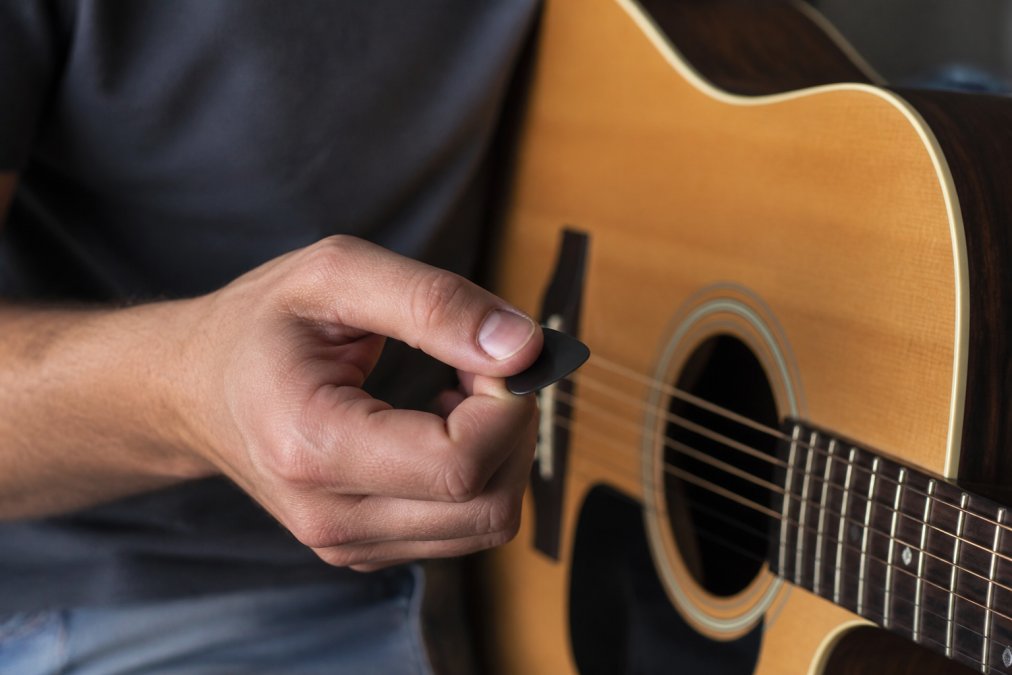
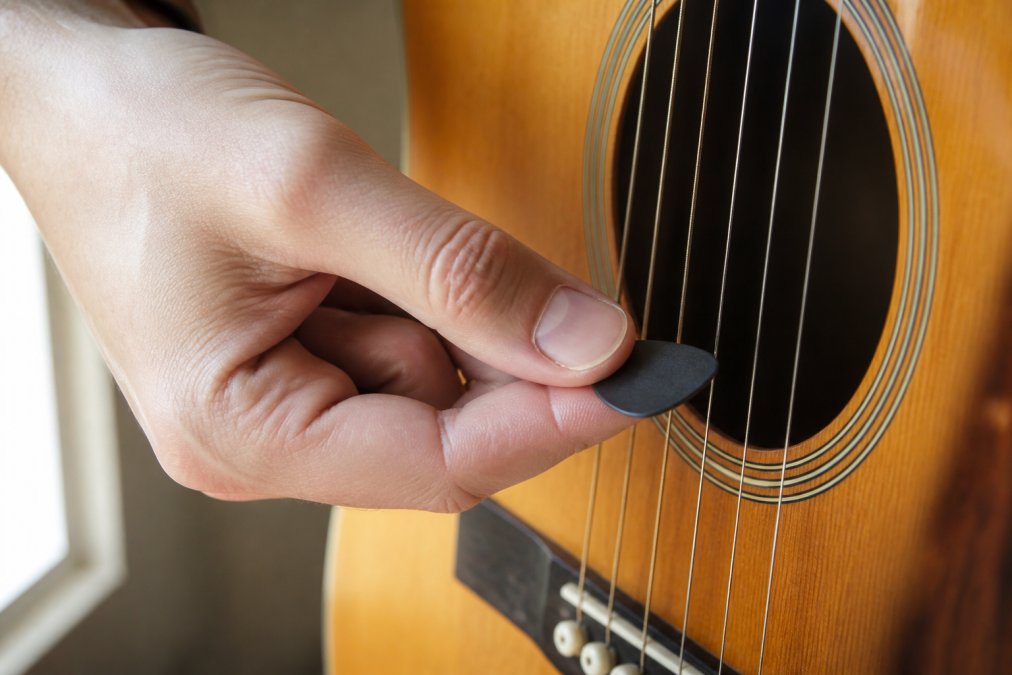
Holding a guitar pick properly means positioning the plectrum between the pad of your thumb and the side of your index finger, with just enough tip exposed to contact the strings cleanly. Done right, the grip feels relaxed, the pick stays stable, and your wrist can rotate freely.
Step 1: Position Your Index Finger
Curl your index finger naturally, as if you are about to point at something, then relax it slightly. The pick rests on the side of your index finger, not the pad of the fingertip. Placing the pick on the fingertip pad is a common beginner mistake that limits your range of motion and forces your thumb into an awkward angle. The side placement, closer to the first knuckle, creates a stable pivot point that lets the pick move through the strings with less resistance.
Step 2: Place Your Thumb Over the Pick
Rest the flat pad of your thumb directly over the pick, pressing it lightly against the side of your index finger. Your thumb should be roughly parallel to the pick edge, not angled sharply across it. The thumb joint should stay relaxed, a locked thumb joint limits dynamic control and sets you up for repetitive strain over time.
The pick tip should extend past the thumb and finger by roughly 5 to 8 millimeters for most playing situations. Too much tip exposure and the pick digs into the strings; too little and you lose articulation and tone production.
Step 3: Set Your Grip Pressure and Tip Exposure
Grip pressure is where most players get this wrong. Too loose and the pick rotates on contact with the string. Too tight and you lose the natural flex that produces a warm, full tone. The right pressure feels like holding a potato chip without breaking it, firm enough to be deliberate, light enough to allow some give.
Tip exposure is a personal variable. Players who choke up get more control and a brighter attack. Players who leave more tip exposed get a slightly warmer tone and more flexibility for strumming. Experiment with both before committing to one position.
Grip Variable | Too Little | Correct Range | Too Much |
|---|---|---|---|
Tip Exposure | Muffled tone, poor articulation | 5-8 mm past fingertip | Pick catches strings, snagging |
Grip Pressure | Pick rotates, slips | Relaxed but deliberate | Stiff tone, hand fatigue |
Thumb Angle | Thumb blocks wrist rotation | Parallel to pick edge | Thumb joint strain |
Index Finger Curl | Unstable pivot point | Natural relaxed curve | Tension, restricted motion |
Guitar Pick Angle for Speed and Tone Production
Pick angle is one of the primary variables controlling both your tone and your speed ceiling. A pick held perpendicular to the string, at a 90-degree angle, produces maximum resistance and a fuller, louder tone, but slows down alternate picking because the pick has to fight through the string. Tilting the pick slightly, between 10 and 30 degrees off perpendicular, reduces string resistance and allows faster pick travel, though with a slightly thinner attack.
According to guidance from Guitar Techniques resources at Berklee Online, the angle of pick attack is one of the most influential variables in tone shaping for electric and acoustic guitarists alike. Start at a slight angle for most playing, then experiment toward perpendicular when you want more volume and body from your rhythm parts. Speed players typically settle on a consistent slight angle and keep it there.
Adjusting How You Hold a Guitar Pick for Different Styles
The grip fundamentals stay constant. What changes between playing styles is tip exposure, pick angle, and the amount of wrist rotation you bring to each stroke.
Strumming and Rhythm Playing
For strumming and rhythm playing, choke up slightly, reducing tip exposure to around 4 to 6 millimeters, and allow your wrist to rotate more freely through the stroke. The pivot point shifts from the pick itself to the wrist joint, which is where the power for strumming should originate. Grip pressure should stay light, volume in strumming comes from wrist speed and stroke width, not from squeezing the pick harder.
Lead Guitar and Alternate Picking
Alternate picking demands the most precise grip mechanics of any technique. For lead guitar and alternate picking, use slightly more tip exposure, around 6 to 8 millimeters, for better string clearance between strokes. The pick angle should be tilted slightly off perpendicular to reduce resistance and allow the pick to escape the string efficiently after each attack.
The thumb joint is the key variable here. A relaxed thumb that can flex slightly absorbs the micro-impacts of fast picking without transmitting tension up the hand and forearm. Players who develop forearm tightness during extended lead playing almost always have a locked thumb joint as the root cause. According to resources from the National Institute of Neurological Disorders and Stroke on repetitive motion injuries, sustained tension in small hand muscles during repetitive tasks is a primary mechanism for overuse injury.
Common Guitar Picking Mistakes to Avoid
Gripping the pick too tightly. This is the most universal beginner mistake. Tight grip produces a stiff, percussive tone, limits dynamic control, and fatigues the hand faster than any other error. If your hand feels tired after 20 minutes of playing, check your grip pressure first.
Placing the pick on the fingertip pad instead of the side of the index finger. The fingertip placement feels intuitive but creates an unstable pivot point. Move the pick to the side of the finger, toward the first knuckle, and the whole system becomes more stable.
Buy Now at our secure ETSY SHOP music store →
Inconsistent tip exposure. Players who adjust their grip mid-song end up with unpredictable tone and attack. Set your tip exposure deliberately before you play and practice keeping it consistent.
Anchoring the picking hand too rigidly. Resting the heel of the hand hard against the bridge locks out the wrist rotation that drives smooth picking. Light contact with the bridge is fine for palm muting; a hard anchor is not.
Ergonomics, Injury Prevention, and Anatomical Variations
Hand anatomy is not uniform. Players with shorter fingers naturally position the pick differently than players with longer fingers. Players with hypermobile thumb joints need to be especially careful about locking the thumb. Players with arthritis or existing hand conditions may find that standard grip mechanics cause pain that modified grips can reduce significantly.
The ergonomic principle behind good pick grip is to minimize sustained tension in small muscles, keep joints in their neutral range of motion, and distribute load across the largest available structures. For guitar picking, this means keeping the thumb joint relaxed and mobile, letting wrist rotation drive picking motion rather than finger or forearm tension, and avoiding gripping harder when playing louder or faster.
For players experiencing hand fatigue or discomfort with conventional flat picks, ergonomic picking systems offer a meaningful alternative. The Strum-N-Comfort SharkTooth and Kodiak Crossover thumb picks are specifically engineered to reduce hand muscle fatigue by redistributing the mechanical load of picking away from the small muscles of the thumb and index finger. Professional educator and musician David Oakes noted that "after just a few hours of play, I can truly say that this SharkTooth Crossover Pick produces less muscle fatigue," which reflects the one core design intent behind the system.
Pick gauge and material also affect ergonomics in ways that rarely get discussed. Thicker picks require more grip pressure to control at speed. Picks with textured or matte surfaces reduce the grip pressure needed to prevent slippage, which directly reduces cumulative hand fatigue. According to information from the American Academy of Orthopaedic Surgeons on hand and wrist overuse injuries, repetitive gripping motions under sustained tension are among the most common causes of tendinitis and related conditions in musicians.
How to Hold a Thumb Pick (and When to Switch)
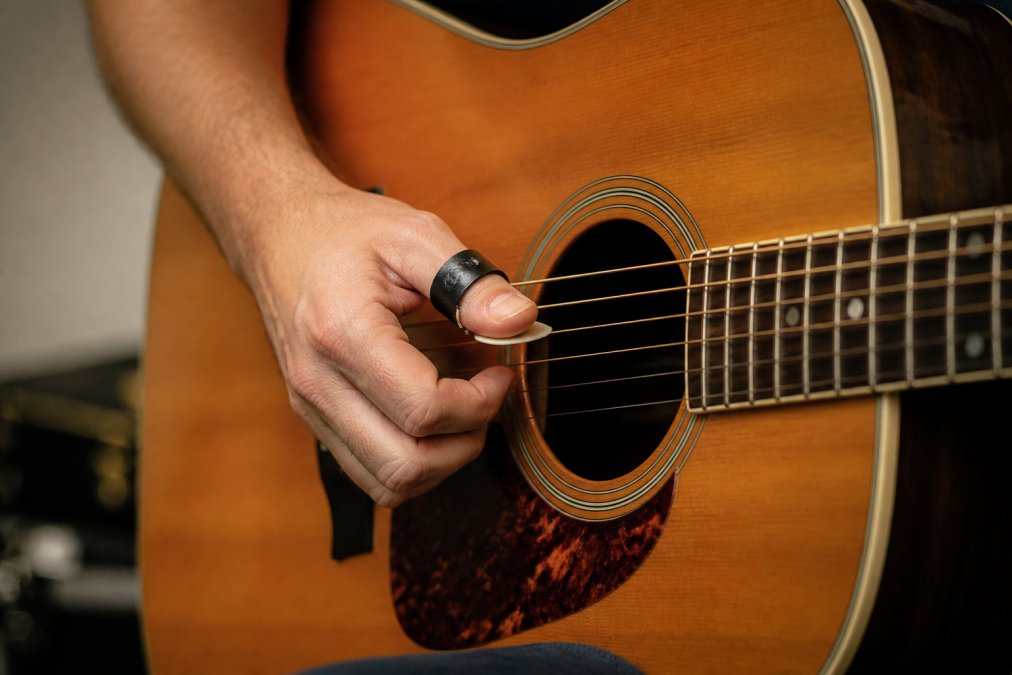
A thumb pick is a different tool with different mechanics. A thumb pick fits over the thumb, leaving the remaining fingers free for fingerstyle playing. The pick blade extends from the end of the thumb, angled to contact the strings in roughly the same position as a flat pick held conventionally.
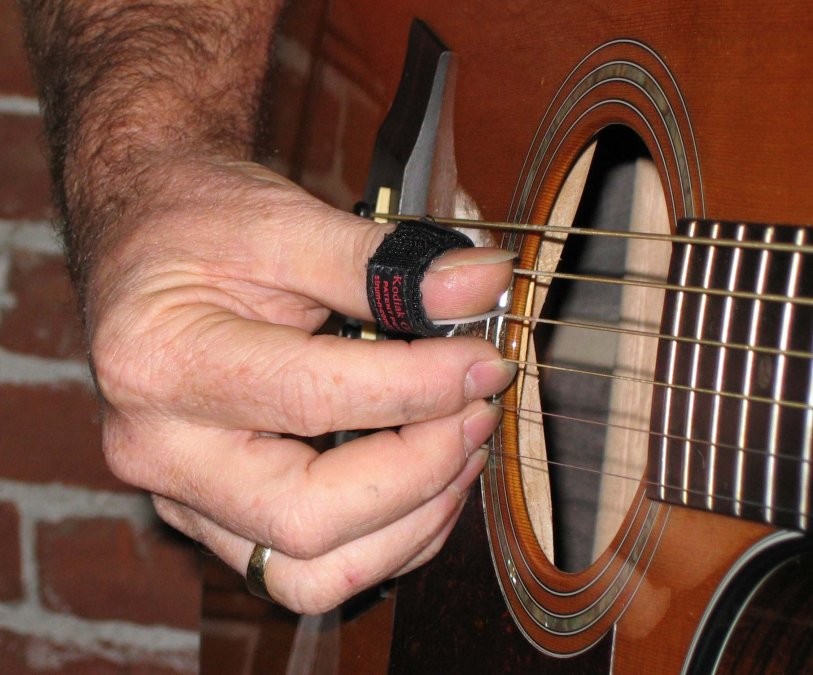
The mechanics of holding a thumb pick correctly involve three adjustments from flat pick technique. First, the thumb should sit comfortably inside the band with no pinching or restriction at the joint. Second, the blade angle should be set so it contacts the strings at roughly the same angle as your flat pick preference. Third, the remaining fingers should be free and relaxed, not curled away from the strings.
The most common mistake with thumb picks is choosing one that does not fit the thumb properly. A thumb pick that is too tight restricts circulation and creates tension; one that is too loose rotates during playing and produces inconsistent attack. The Strum-N-Comfort Crossover system is designed to fit all thumb sizes, which addresses the fit problem that makes many players abandon conventional thumb picks after a week. As recording artist Gil Parris put it, the Crossover system represents "definitely an improvement over conventional thumb picks for easily moving between fingerstyle and flat pick techniques."
When to switch from flat pick to thumb pick:
- You regularly play arrangements that combine fingerstyle passages with strummed or picked single-note lines
- You experience consistent hand fatigue from flat pick technique during extended sessions
- You want to maintain the attack and projection of a flat pick while keeping fingers free for chord voicing or melodic fills
Hand fatigue and grip inconsistency are not signs that you need to practice harder. They are usually signs that the mechanics need adjustment, and sometimes that the tool itself is working against you. Strum-N-Comfort's ergonomic Crossover picking system was built specifically to solve both problems, reducing hand muscle fatigue while allowing seamless movement between fingerstyle and flat-pick techniques. The SharkTooth and Kodiak models fit all thumb sizes and are compatible with your existing flat picks. Get started with Strum-N-Comfort and find out what consistent, comfortable picking actually feels like.
Frequently Asked Questions
How tight should you hold a guitar pick?
Grip pressure should be firm enough to prevent pick slippage but relaxed enough that your hand doesn't tense up. A death grip creates tension that slows down alternate picking and causes fatigue. Aim for a pressure where the pick can flex slightly against string resistance without flying out. If your forearm or thumb joint aches after 20 minutes, you're gripping too hard. Start loose, then tighten just enough to maintain control through downstrokes and upstrokes.
Does the angle of the guitar pick matter for tone?
Pick angle directly shapes your tone and attack. Holding the plectrum parallel to the strings produces a brighter, more articulate sound suited to lead guitar. Tilting it slightly — around 30 to 45 degrees — reduces string resistance and smooths out strumming for rhythm playing. Flatpicking styles often favor a shallower angle for speed, while players who want a warmer, rounder tone angle the pick more steeply into the string. Experimenting with angle is one of the fastest ways to change your sound without touching your amp.
What is the best way to hold a pick for strumming vs. lead playing?
For strumming, choke up slightly so less pick tip is exposed, and keep your wrist relaxed to allow natural wrist rotation across all six strings. For lead guitar and alternate picking, expose a bit more tip for precision and articulation on individual strings. Your pivot point shifts too: strumming uses a broader wrist arc, while lead playing anchors closer to the bridge for tighter dynamic control. Many players find a thumb pick system useful here because it allows quick transitions between fingerstyle and flat-pick techniques without swapping tools.
How do you hold a thumb pick correctly?
Slide the thumb pick band onto your thumb so the blade curves away from your fingertips, sitting naturally at the end of your thumb joint. The blade should angle slightly downward when your thumb is relaxed. Avoid forcing it flat — let the natural curve of your thumb dictate the resting angle. Your remaining fingers stay free for fingerstyle playing. A well-fitted thumb pick, like the SharkTooth or Kodiak from Strum-N-Comfort, should feel secure without cutting off circulation or shifting during aggressive downstrokes.
This article was written using GrandRanker