 how-to
How to Improve Guitar Picking Accuracy: 2026 Guide
Table of Contents
- Why Your Picking Accuracy Stalls (and How to Fix It)
- How to Hold a Guitar Pick Properly for Clean Attack
- Alternate Picking Exercises That Build Real Precision
- Floating Hand vs. Anchored Hand: Which Helps Accuracy?
- Developing a Universal Picking Technique for Fingerstyle and Flat Pick
- Ergonomic Thumb Picks for Guitar: Reducing Tension and Fatigue
- Common Picking Mistakes and How to Fix Them
- Conclusion
- Frequently Asked Questions
Last Updated: September 14, 2026
Why Your Picking Accuracy Stalls (and How to Fix It)
Guitar picking accuracy is the ability to strike the intended string, at the intended time, with the intended attack, every time. It is a motor skill built through deliberate practice, and it stalls for predictable reasons.
Most players plateau because they practice speed before control: they grip too hard, anchor in a position that fights the wrist, and never isolate the string-crossing movements that cause misses. The fix is systematic, correct grip, deliberate drills, and honest tension management.
Accuracy responds to practice faster than almost any other guitar skill. Here's how to structure that practice, and why the right thumb pick removes a hidden obstacle.
A common mistake is treating picking as a wrist-only motion. Accurate picking combines wrist movement, forearm rotation, and a relaxed grip, tension in any one kills the other two.
How to Hold a Guitar Pick Properly for Clean Attack
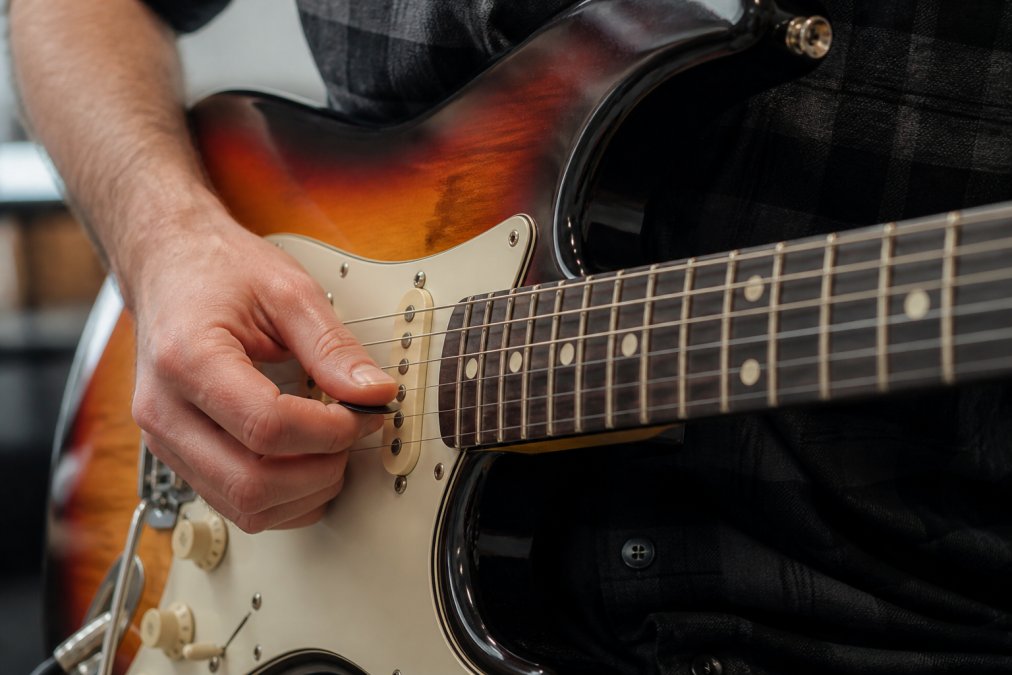
The proper way to hold a guitar pick is between the thumb and the side of the index finger, with roughly 3 to 5 millimeters of tip exposed and the pick angled slightly toward the strings. A relaxed grip beats a tight one.
Here is the setup that works for most players:
- Rest the pick on the side of your curled index finger, not the pad.
- Lay your thumb across it, covering about two-thirds of the pick's surface.
- Expose only a small tip. More pick sticking out means more flex and less control.
- Keep your grip firm enough that the pick will not rotate, but loose enough that your thumb pad stays soft.
Grip Pressure and Pick Angle
Grip pressure is the most common accuracy killer. Squeeze too hard and your hand fatigues within minutes, your wrist stiffens, and your attack becomes inconsistent.
Pick angle matters just as much. Hitting flat gives a bright, percussive attack but more resistance; a slight angle, around 10 to 20 degrees, lets the pick glide with less drag for cleaner articulation.
Alternate Picking Exercises That Build Real Precision
Alternate picking means alternating downstrokes and upstrokes in a continuous, even motion. It is the foundation of lead guitar accuracy because it forces your hand to synchronize both stroke directions. But your hand is rarely the bottleneck, your attention is.
Start every session on a single string at around 60 bpm, playing strict down-up-down-up for one minute, then move to adjacent string pairs. The goal is not speed but identical volume and tone on every note.
Drill | What It Trains | Starting Tempo | Daily Time |
|---|---|---|---|
Single-string alternate picking | Even downstroke/upstroke | 60 bpm | 3 min |
Two-string crossing | String crossing control | 60 bpm | 3 min |
String skipping pairs | Precision over gaps | 50 bpm | 4 min |
Economy picking runs | Motion efficiency | 60 bpm | 3 min |
Metronome ladder | Tempo consistency | +4 bpm steps | 5 min |
The Mental Side of Alternate Picking Accuracy
Most players play a drill cleanly for eight bars and fall apart at bar nine. That is an attention problem, not a hand problem: accuracy under speed depends on holding one specific target in mind while your hand runs on autopilot.
Three cognitive techniques that separate accurate players from fast-but-sloppy ones:
- Target the next string, not the current one. Before you finish a note, your attention should already be on the string you are moving to. Players who stare at the current string are always one note behind their own hand.
- Chunk the passage. Break a run into two- or three-note groups and give each group a single mental label ("up to the G," "back to the D"). Your working memory can hold three chunks far more reliably than twelve individual notes.
- Visualize the picking hand before you play. Spend ten seconds before a drill imagining the exact wrist motion and pick angle you want. This primes the motor pattern before your hand moves.
Diagnosing Your Own Picking Errors
Guessing at what went wrong is the slowest way to improve. Record yourself.
- Set your phone to slow-motion video (most phones shoot 120 or 240 frames per second) and film your picking hand from the side and from above.
- Watch for three things: pick angle changing mid-passage, wrist collapsing into a forearm-driven motion, and the pick drifting away from the string between strokes.
- Compare a clean take to a sloppy take frame by frame. The difference is almost always one of those three, and it is almost never "I need to practice more."
A common pattern is that players who miss on the upstroke are angling the pick differently on the way back. Slow-motion video catches this in seconds; ears alone rarely do.
String Skipping and String Crossing Drills
String skipping is where most players discover their accuracy is not as good as they thought. Playing from the low E to the D, skipping the A, exposes every flaw in your picking motion.
Begin with slow, deliberate skipping between non-adjacent strings: two notes per string, then move. If you miss, stop and restart slower. Muscle memory is built from clean repetitions, not fast sloppy ones.
The same applies to ordinary string crossing: work adjacent strings in both directions, keeping your pick's travel between strings as short as possible.
Floating Hand vs. Anchored Hand: Which Helps Accuracy?
A floating hand hovers above the strings with no fixed contact point; an anchored hand rests the palm or pinky lightly on the body or bridge. Neither is universally better, most accurate players use a hybrid.
Floating hands suit wide string skipping and sweep picking; anchored hands give a stable reference point for rhythm guitar and consistent attack, making a return to the same string repeatable.
The problem is a heavy anchor, not anchoring itself. Light palm contact is fine; bearing down with your wrist is a fast route to fatigue and tension.
Buy Now at our secure ETSY SHOP music store →
Developing a Universal Picking Technique for Fingerstyle and Flat Pick
A universal picking technique is a single right-hand approach that lets you move between fingerstyle and flat-pick playing without changing your setup or hand position, the skill that separates players who can cover any part on a gig from those locked into one style.
Build it by practicing both techniques with the same relaxed hand posture: play a fingerstyle passage, then immediately repeat it with a pick, keeping wrist and thumb in the same position. The transition is the exercise.
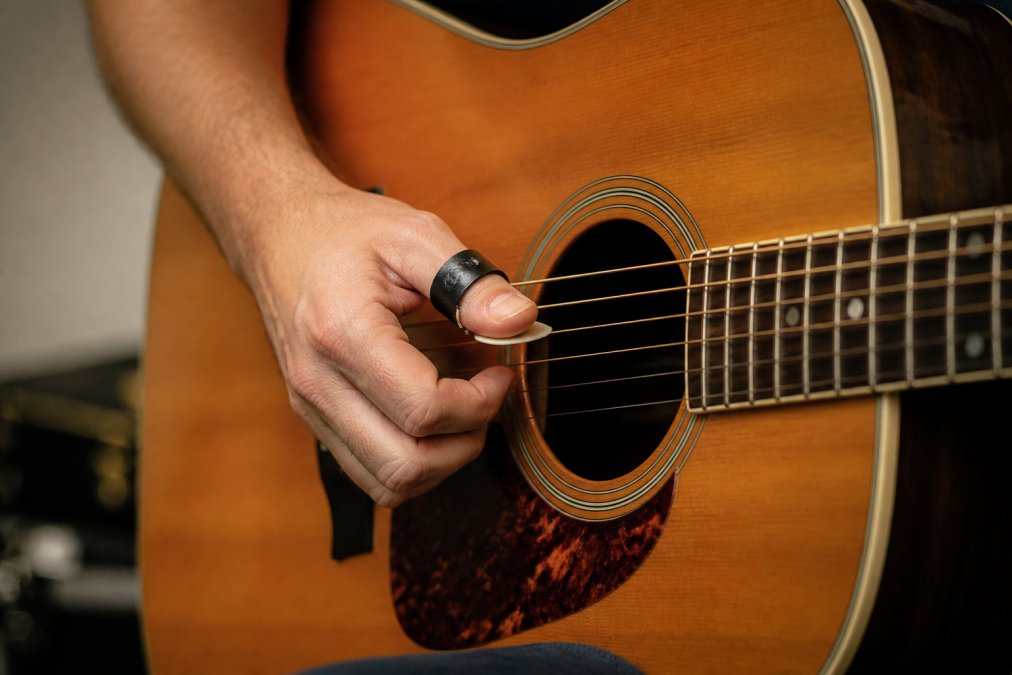
This is exactly the problem Strum-N-Comfort set out to solve. Our comfortable, flexible Crossover thumb picks are highly effective in helping players develop a universal picking technique, because the pick stays on your thumb while your fingers remain free. You can switch between fingerstyle and flat-pick techniques mid-phrase without reaching for a pick.
Ergonomic Thumb Picks for Guitar: Reducing Tension and Fatigue
Ergonomic thumb picks for guitar reduce grip pressure and hand strain by attaching to the thumb rather than being pinched between fingers. For long sessions or hand fatigue, they remove the constant pinch that causes most tension.
The pinch grip is the culprit: holding a flat pick between thumb and index finger requires continuous muscle engagement, and over an hour that adds up. A thumb pick eliminates the pinch entirely.
Both the SharkTooth and Kodiak Crossover Pick models from Strum-N-Comfort feature a fully adjustable thumb strap system, so the fit adapts to your thumb rather than forcing your hand into a fixed size. The SharkTooth models go further: they let you use your favorite flat pick with the strap system, so you keep the tone and feel you already like.
David Oakes, former Musicians Institute instructor and USC professor, put it plainly: "After just a few hours of play, I can truly say that this SharkTooth Pick produces less muscle fatigue."
Common Picking Mistakes and How to Fix Them
The most common picking mistakes are variations of one problem: too much tension and too much motion. Fix the tension and the accuracy follows.
- Death-gripping the pick. Fix: relax until the pick nearly slips, then add the smallest amount of pressure needed to hold it.
- Practicing fast before clean. Fix: drop your metronome tempo until you can play a passage ten times with zero misses.
- Ignoring the upstroke. Fix: practice upstroke-only passages so both directions of the stroke develop equally.
- Letting the pick rotate in your hand. Fix: check your grip every few minutes; a rotating pick changes your attack angle mid-phrase.
- Playing through pain. Fix: stop and rest. Persistent hand or wrist pain is a signal, not a hurdle to push through.
Preventing Repetitive Strain While Drilling Accuracy
High-repetition accuracy drills are exactly the kind of practice that produces repetitive strain injuries in the wrist, thumb, and forearm. Many players quietly plateau not because they are undertrained but because they are over-irritated.
A few habits that keep your hands healthy through long practice blocks:
- Cap continuous drilling at 20 minutes. Take a two- to three-minute break, shake out your hand, and stretch your forearm and fingers before starting the next block.
- Alternate high-tension and low-tension work. Follow a fast alternate-picking drill with something slow and legato so the same muscle group is not loaded continuously.
- Watch for the warning signs. Aching in the base of the thumb, tingling in the fingers, or a wrist that feels stiff the next morning are early signals. Rest days are part of the training plan, not a break from it.
- Reduce the pinch whenever you can. The continuous thumb-and-index pinch of a flat pick is the single largest source of hand fatigue during long sessions. A thumb pick removes that pinch entirely, which is why players who drill for hours often find they can practice longer and more accurately with one.
Accuracy Demands Differ by Genre
Generic advice treats picking accuracy as one skill. It is not: what counts as "accurate" changes with what you play, and drilling the wrong kind wastes months.
- Acoustic strumming. Accuracy here means consistent attack and even volume across all six strings. The failure mode is a strum that catches some strings harder than others. Drill with a metronome and listen for a flat, even wall of sound rather than note-by-note precision.
- Metal and shred. Accuracy means every note in a fast run is articulated at the same volume and duration, with no ghost notes. The failure mode is a pick that grazes the string instead of striking it cleanly at speed. Drill short bursts at tempo, then rest, rather than long slow runs.
- Jazz and improvisation. Accuracy means landing on the intended string on the intended beat while your fretting hand is doing something unrelated. The failure mode is a right hand that follows the left instead of leading it. Drill string crossings over static chords so the picking hand has to solve the problem on its own.
If you play more than one of these styles, the fastest path is a single right-hand setup that works for all of them, what we call a universal picking technique. That is the problem our Crossover thumb picks were built to solve: comfortable, flexible, and highly effective at helping players move between fingerstyle, flat-pick, and hybrid approaches without resetting their hand position. Both the SharkTooth and Kodiak models feature a fully adjustable thumb strap system, and the SharkTooth models let you keep using your favorite flat pick with the strap system.
Conclusion
Picking accuracy stalls for one reason: your practice is not isolating the specific motion that is failing. Slow down, fix the grip, drill the string crossings, and manage tension before you chase speed.
Strum-N-Comfort builds tools for exactly that work. Our Crossover thumb picks are comfortable, flexible, and designed to help you develop a universal picking technique, with a fully adjustable thumb strap system on both the SharkTooth and Kodiak models. The SharkTooth even lets you keep using your own flat pick.
Get started with Strum-N-Comfort and build the picking accuracy that holds up on stage.
Frequently Asked Questions
How does pick grip affect guitar picking accuracy?
Grip pressure and pick angle decide how cleanly the pick meets the string. Too much tension in the thumb and index finger causes the pick to dig in, which throws off timing and creates a harsh attack. A relaxed grip with the pick angled slightly downward lets the edge glide across the string. Players who struggle with guitar picking accuracy often find that simply loosening their grip and shortening the amount of pick sticking out fixes most of the problem within a few practice sessions.
What are the best alternate picking exercises for right-hand precision?
Start with single-string downstroke and upstroke patterns at a slow tempo, around 60 bpm, and only increase speed when every note sounds even. Add string crossing drills that move between two adjacent strings, then expand to string skipping across three or four strings. A metronome keeps you honest about timing. Five to ten minutes of focused alternate picking exercises daily builds muscle memory faster than an hour of unfocused playing.
How do I stop picking the wrong strings on guitar?
Wrong-string errors usually come from excess motion in the wrist and forearm. Try economy of motion drills where you keep the pick close to the strings and move only from the wrist, not the whole arm. Slow the tempo until you hit the correct string ten times in a row, then nudge the metronome up by 4 bpm. Pairing this with an ergonomic thumb pick that stays secure on your thumb can also reduce the small slips that cause missed strings.
Can ergonomic thumb picks really reduce hand fatigue?
Yes, when the pick fits correctly and holds its position without you squeezing. A fully adjustable thumb strap system, like the one on Crossover thumb picks, distributes pressure across the thumb instead of concentrating it on one spot. David Oakes, a former Musicians Institute instructor, noted that after a few hours of play the SharkTooth Pick produced less muscle fatigue. Less squeezing means more relaxation, and relaxation is what allows consistent guitar picking accuracy over long practice sessions or live sets.