 how-to
Reduce Hand Fatigue While Playing Guitar: 7 Fixes
Table of Contents
- Why Do My Hands Hurt Playing Guitar? The Real Causes
- How to Relax Your Wrist While Playing Guitar
- Fretting Hand Technique: Pressure, Placement, and Posture
- Ergonomic Guitar Picks and Gear That Reduce Hand Fatigue
- Warm-Up Routines and Rest Intervals That Protect Your Hands
- Frequently Asked Questions
Last Updated: September 15, 2026
Why Do My Hands Hurt Playing Guitar? The Real Causes
Hand pain while playing guitar usually comes from three sources: excessive grip pressure, poor wrist alignment, and playing past the point of muscle fatigue, all of which you can address to reduce hand fatigue while playing guitar. None of these are inevitable. Each one has a fix, and most players can address all three without changing their style. At Strum-N-Comfort, we talk to guitarists every week who assume sore hands are just part of the deal. They are not.
Hand fatigue while playing guitar is the gradual loss of control and comfort in the fretting or picking hand caused by sustained muscle tension, repetitive motion, and insufficient recovery. It shows up as a dull ache in the thumb pad, stiffness in the forearm, or a weak feeling when you try to fret a barre chord in the second set.
The frustrating part is that the causes are usually invisible. You do not notice you are squeezing too hard until your hand is already tired. That is why the fixes below start with awareness before technique.
How to Relax Your Wrist While Playing Guitar
Wrist relaxation starts with alignment, not willpower. If your wrist bends sharply toward the floor or ceiling while you play, the tendons running through the carpal tunnel are already under compression before you fret a single note.
A few adjustments that help immediately:
- Keep the wrist within roughly 20 degrees of neutral in both hands
- Raise or lower your strap so the picking hand falls naturally over the strings
- Angle the neck slightly upward instead of parallel to the floor
- Check that your elbow is not pinned against your ribs
Wrist alignment matters more than most players realize. A bent wrist forces the forearm muscles to work against resistance all night. Straighten it and the same passage feels lighter.
Fretting Hand Technique: Pressure, Placement, and Posture
The biggest mistake with fretting is pressing harder than the note requires. Most players use roughly double the pressure needed, and the excess goes straight into the thumb and forearm.
Three things to fix:
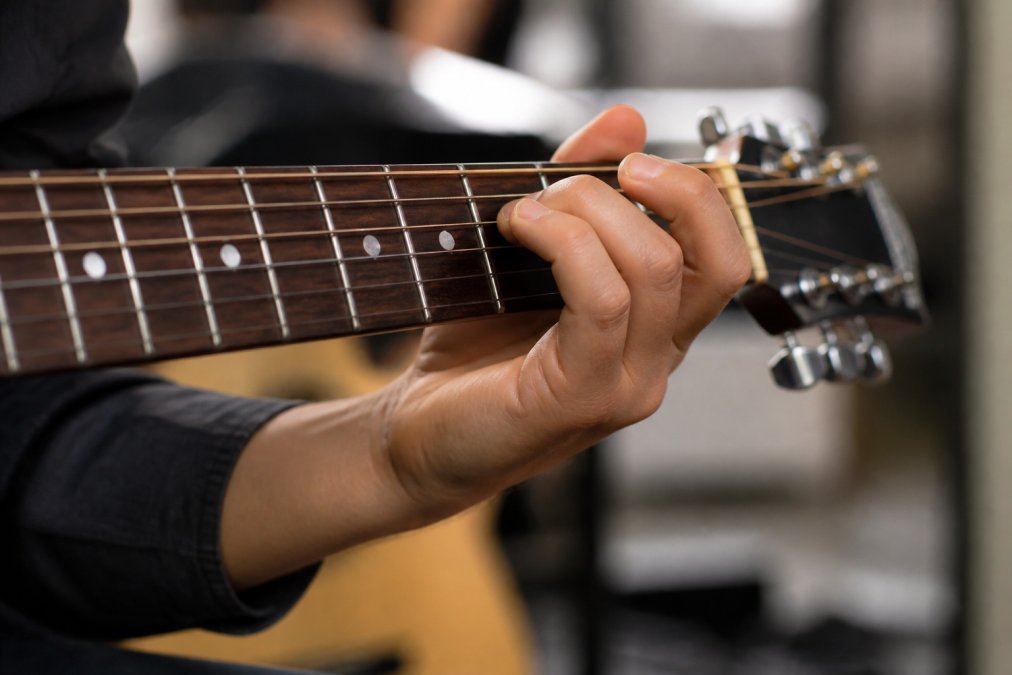
- Finger placement. Land each fingertip just behind the fret wire, not in the middle of the fret. This gives you a clean note with less force.
- Thumb position. Keep the thumb behind the neck, roughly opposite the middle finger. A thumb hooked over the top adds tension.
- Barre chord adjustments. Roll the index finger slightly onto its bony edge and pull the elbow gently toward your body. This uses arm weight instead of grip strength.
String tension and action height also matter. Lighter strings and a lower action reduce the pressure needed for every note. A common mistake is leaving a setup untouched for years while blaming your hands.
Ergonomic Guitar Picks and Gear That Reduce Hand Fatigue
Gear affects fatigue in two directions: how much force the strings demand from your fretting hand, and how much pinch force your picking hand has to apply to hold a tool. Most articles cover only the second one. The first one is usually the bigger lever.
Setup mechanics that force extra hand effort
Before you blame your hands, check the instrument. Three setup variables directly increase the pressure required to play:
- Action height at the 12th fret. If the strings sit high off the fretboard, every fretted note requires more downward force. A common target range for electric guitars is roughly 4/64 inch on the high E and 5/64 inch on the low E at the 12th fret, measured from the top of the fret to the bottom of the string. Acoustic guitars typically run higher. If yours is well above that, a truss rod and saddle adjustment can drop the effort noticeably.
- Nut slot depth. This is the one almost nobody checks. If the slots at the nut are cut too shallow, the strings sit high near the first few frets, and the first-position chords you play most often become the hardest ones in the set. A tech with nut files can lower them in minutes. The symptom to watch for: noticeably more effort in first position than at the fifth fret.
- Bridge height and saddle. On acoustics, a tall saddle raises the whole string plane. Lowering it reduces fretting pressure across the board, at the cost of some volume and attack. That trade-off is worth knowing before you decide.
String gauge is the other half of the equation. Moving from .012s to .011s on an acoustic, or from .010s to .009s on an electric, reduces tension meaningfully. The trade-off is a slightly thinner tone and, on some guitars, more fret buzz if the action is already low. Have a tech set the guitar up for the gauge you actually play, not the gauge it shipped with.
Buy Now at our secure ETSY SHOP music store →
Shoulder Strap length and wrist angle
Strap height is the most overlooked ergonomic variable on the guitar. A strap set too low forces the fretting wrist into extension (bent back) and the picking wrist into flexion (bent forward), and both positions compress the tendons running through the wrist. The fix is simple: raise the strap until the picking hand falls naturally over the strings with the wrist close to neutral, and the fretting hand can reach the lower frets without the wrist collapsing.
A useful test: sit or stand in playing position, look at both wrists in a mirror, and check that neither is bent more than about 20 degrees from a straight line with the forearm. If one is, adjust the strap before you adjust your technique.
Picks and picking systems
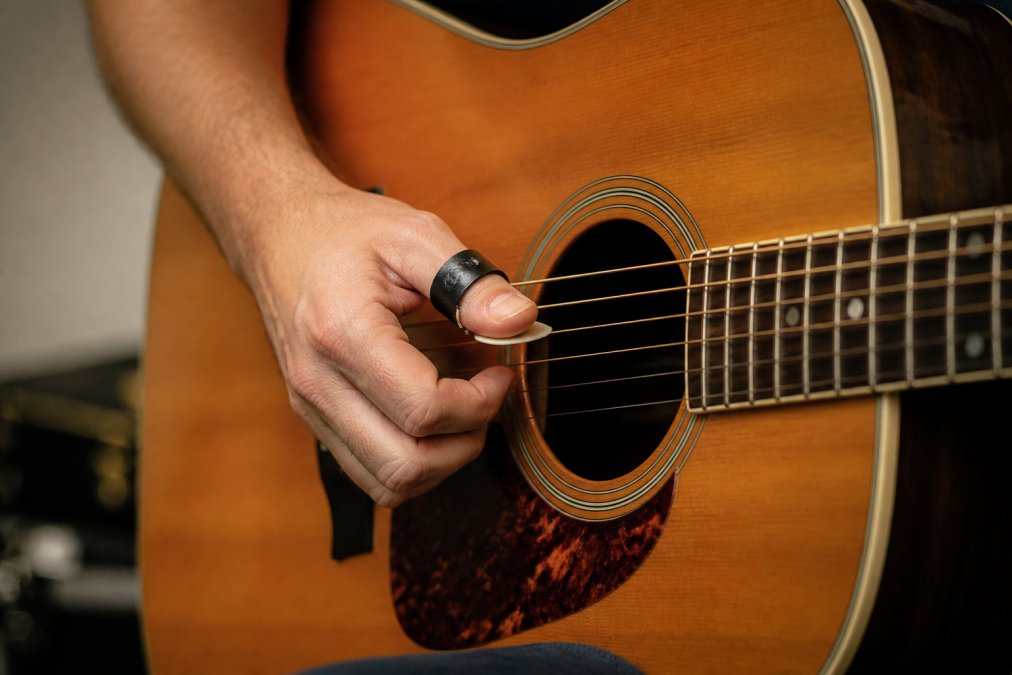
The tool in your picking hand shapes how hard you grip, and grip is where fatigue begins. Ergonomic guitar picks are designed to sit in the hand with less pinch force, which lets the picking hand stay relaxed through long sets.
This is exactly the problem Strum-N-Comfort set out to solve. Our Crossover thumb picks are comfortable, flexible, and highly effective in helping develop what we call a Universal Picking Technique, the ability to move between fingerstyle and flat-pick playing without switching tools. Both the SharkTooth and Kodiak models feature a fully adjustable thumb strap system, and the SharkTooth models let you use your favorite flat pick with the strap. David Oakes, former Musicians Institute instructor, put it plainly: "After just a few hours of play, I can truly say that this SharkTooth Pick produces less muscle fatigue."
Warm-Up Routines and Rest Intervals That Protect Your Hands
Most warm-up advice for guitarists is borrowed from gym culture: stretch, shake it out, play a scale. That approach misses the actual problem. The muscles that fatigue first while playing are the small intrinsic muscles of the hand, the ones that control individual finger movement, and they respond better to graded activation than to static stretching. Cold static stretching before playing can actually reduce grip control for the first few minutes.
A better model is a three-phase warm-up: perfusion, isolation, integration.
Phase 1, Perfusion (60 to 90 seconds). Get blood moving without loading the tendons.
Practice Block | Rest Interval | What to Do |
|---|---|---|
20-30 minutes | 5 minutes | Shake out hands, stretch forearms, drop the shoulders |
45-60 minutes | 10 minutes | Stand up, roll shoulders, hydrate |
90+ minutes | 15 minutes | Full break away from the instrument |
Frequently Asked Questions
How often should I take breaks during a practice session?
Take a 5-minute break every 20 to 30 minutes of playing. During the break, stand up, shake out your hands, and stretch your fingers and wrists gently. This rest interval gives small muscles time to recover before fatigue builds up. If you practice for two hours straight without breaks, tension accumulates and your fretting hand and picking hand both suffer. Set a timer if you tend to lose track of time.
Can the wrong pick cause hand fatigue?
Yes. A pick that forces you to grip harder than necessary makes your thumb and forearm work overtime. Standard flat picks and traditional thumb picks often require extra pressure to stay in place, especially during fast strumming or plucking. Ergonomic guitar picks with an adjustable strap, like the Crossover thumb picks from Strum-N-Comfort, hold securely without a death grip. The SharkTooth and Kodiak models both feature a fully adjustable thumb strap system, and the SharkTooth lets you use your own flat pick with the strap.
How do I know if my hand pain is serious?
See a doctor if pain persists after you stop playing, wakes you at night, or comes with numbness, tingling, or weakness in your fingers. These signs can point to nerve compression or repetitive strain injury, not just muscle fatigue. Mild soreness that fades within a day is usually normal. Pain that lingers or gets worse each session needs medical attention. Early treatment for conditions like carpal tunnel or tendonitis is far easier than recovery after months of damage.
What is the Universal Picking Technique?
The Universal Picking Technique is a way of playing that lets you move smoothly between fingerstyle and flat-pick techniques without changing your hand position or switching gear mid-song. It depends on a picking system that stays comfortable and secure on your thumb while giving your fingers freedom to pluck. Crossover thumb picks were developed specifically for this. Both the SharkTooth and Kodiak models are comfortable, flexible, and highly effective in helping develop a Universal Picking Technique.