 how-to
Why Do My Hands Hurt After Playing Guitar?
Table of Contents
- Why Your Hands Hurt After Playing Guitar: The Real Causes
- Good Pain vs. Bad Pain: What Guitarists Need to Know
- Proper Guitar Picking Technique to Prevent Hand Pain
- Warm-Up Routines and Stretches for Guitarists
- Guitar Setup, String Action, and How They Affect Your Hands
- Ergonomic Guitar Accessories That Actually Reduce Fatigue
- Crossover Thumb Picks for Comfort and Universal Technique
- Age-Related Considerations and When to See a Doctor
- Frequently Asked Questions
Last Updated: August 30, 2026
Why Do My Hands Hurt After Playing Guitar?
Hand pain is one of the most common complaints among guitarists at every level. At Strum-N-Comfort, we work with guitarists daily who balance technique improvement with physical comfort. The answer almost always comes down to how you play and what you play with. Below, we'll break down the real causes of guitar-related hand pain, how to distinguish discomfort that's part of growth from pain that signals injury, and what you can do today to protect your hands for the long haul.
Why Your Hands Hurt After Playing Guitar: The Real Causes
Hand pain from guitar playing almost always traces back to one of a handful of mechanical or physiological causes.
Tendonitis and Repetitive Strain Injury (RSI)
Tendonitis is inflammation of a tendon, typically caused by repetitive motion performed under tension. For guitarists, this usually develops in the forearm, wrist, or finger tendons after extended practice sessions without adequate rest. The hallmark symptom is a dull ache that worsens during or after playing, sometimes accompanied by swelling or stiffness.
Repetitive strain injury (RSI) describes cumulative damage to muscles, nerves, and tendons from repeated movements performed with poor technique or insufficient recovery time. It builds quietly, session by session, until the pain becomes impossible to ignore.
The most common trigger is practicing too long, too soon, without warming up. Your tendons need progressive loading, just like any athletic training. As documented in guidance from the American Academy of Orthopaedic Surgeons on tendonitis, tendon inflammation is best managed through rest, activity modification, and gradual return to movement rather than pushing through pain.
Carpal Tunnel Syndrome and Nerve Compression
Carpal tunnel syndrome occurs when the median nerve becomes compressed in the narrow passageway in the wrist. Guitarists who maintain sustained wrist flexion or extension during playing are particularly susceptible. Symptoms include numbness, tingling, and a burning sensation in the thumb, index, and middle fingers, often worse at night.
Nerve compression can also occur at the elbow or in the neck and shoulder, all of which can refer pain or tingling down into the hands.
Good Pain vs. Bad Pain: What Guitarists Need to Know
Not all hand discomfort is a warning sign. Treating normal beginner adaptation as injury leads players to quit or develop overcautious habits that limit their development.
Good pain is the mild soreness and fingertip sensitivity that comes with building calluses. When you first start playing, the skin on your fingertips isn't conditioned for string contact. This normal adaptation resolves as calluses form over several weeks of consistent practice.
Bad pain is anything sharp, shooting, or located in the joints, tendons, or wrist. It's pain that persists after you stop playing, that wakes you up at night, or that's accompanied by swelling, redness, or tingling.
The practical test: if your discomfort disappears within 30 minutes of stopping play and you feel fine the next morning, it's likely adaptive soreness. If pain lingers for hours, returns immediately when you pick up the guitar, or is getting progressively worse over weeks, stop playing and consult a physical therapist or physician.
| Discomfort Type | Location | Duration | Action |
|---|---|---|---|
| Fingertip soreness | Skin of fingertips | Fades after rest | Continue, build calluses |
| Muscle fatigue | Forearm, hand muscles | Resolves overnight | Rest, shorten sessions |
| Tendon ache | Wrist, forearm tendons | Persists after playing | Rest, ice, reassess technique |
| Sharp or shooting pain | Joints, wrist, fingers | During or after playing | Stop playing, see a doctor |
| Numbness or tingling | Fingers, hand | Any duration | Stop playing, see a doctor |
Proper Guitar Picking Technique to Prevent Hand Pain
Poor technique is the single most preventable cause of guitar-related hand pain. Most players need only a few targeted adjustments.

Wrist Alignment and Thumb Positioning
A wrist that's sharply bent inward or outward while picking increases forearm tension and compresses the tendons running through the carpal tunnel. The goal is a neutral or slightly arched wrist position, where the hand floats naturally above the strings without forcing the joint into an extreme angle.
Thumb positioning matters equally. An anchored or rigidly held thumb restricts movement through the entire hand and forces the fingers to compensate with excess effort. A relaxed, lightly positioned thumb allows the wrist and fingers to move fluidly as a unit.
Developing a Universal Picking Technique trains the hand to move efficiently across both fingerstyle and flat-picking approaches, reducing the compensatory tension that causes overuse injuries. Rather than treating right-hand technique as two separate disciplines, a universal approach combines them seamlessly.
Reducing Fretboard Tension and Grip Pressure
Excessive fretboard tension doesn't improve tone or accuracy. It accelerates muscle fatigue, strains the tendons in the fretting hand, and creates a feedback loop where the picking hand compensates by gripping harder too.
Practice fretting with the minimum pressure needed to produce a clean note. Most players are surprised to find they need far less tension than they thought.
Grip pressure in the picking hand is equally important. Death-gripping a flat pick creates forearm tension that travels up through the wrist and into the elbow, a primary contributor to RSI in guitarists.
Warm-Up Routines and Stretches for Guitarists
Skipping a warm-up before playing is the equivalent of sprinting without stretching first. A practical warm-up routine takes about five to ten minutes and should include:
- Finger extensions: Spread your fingers wide, hold for five seconds, then gently close into a fist. Repeat ten times per hand.
- Wrist circles: Rotate each wrist slowly in full circles, ten rotations in each direction.
- Prayer stretch: Press palms together in front of your chest, fingers pointing up. Slowly lower the hands toward your waist while keeping palms together. Hold for 20 seconds.
- Forearm stretch: Extend one arm forward, palm up. With the other hand, gently press the fingers downward. Hold 20 seconds per side.
- Tendon glides: Starting with fingers straight, curl just the fingertips (hook fist), then make a full fist, then a straight fist. Move slowly through each position.
- Slow chromatic runs: Before playing anything at tempo, run through slow chromatic scales at half speed to bring blood flow into the fingers without shock-loading the tendons.
According to hand health guidance from the American Society for Surgery of the Hand, regular stretching and gradual warm-up significantly reduce the risk of overuse injuries in repetitive fine-motor tasks.
Practice intervals matter too. Playing for 90 minutes straight is harder on your tendons than three 30-minute sessions with rest in between. Build in five-minute breaks every 45 minutes at minimum.
Guitar Setup, String Action, and How They Affect Your Hands
Your instrument's setup may be working against you. String action refers to the height of the strings above the fretboard. High action forces you to press harder to fret notes cleanly, multiplying cumulative strain across a full practice session. A properly set-up guitar with low, clean action requires significantly less grip force and reduces muscle fatigue noticeably.
Buy Now at our secure ETSY SHOP music store →
String gauge is equally important. Heavier gauge strings require considerably more tension to fret and pick. If you're experiencing persistent hand pain, dropping one gauge lighter is a practical, low-cost experiment worth trying.
Other setup factors that affect hand strain include nut slot height, neck relief, and bridge saddle height. A qualified guitar technician can assess and adjust all of these in a single setup appointment, one of the most cost-effective investments you can make for your long-term hand health.
Ergonomic Guitar Accessories That Actually Reduce Fatigue
The accessories that consistently deliver real fatigue reduction include:
- Supportive guitar straps: A wider strap with proper shoulder padding distributes the instrument's weight more evenly, reducing compensatory tension in the picking arm and shoulder.
- Ergonomic guitar supports: For classical and fingerstyle players, supports that replace the traditional leg-on-leg position can significantly reduce lower back and fretting-arm strain.
- Thumb picks designed for comfort: Standard thumb picks are often rigid, poorly fitted, and force the thumb into an unnatural angle. Pick design becomes a meaningful ergonomic variable.
As noted in ergonomics research from the National Institute for Occupational Safety and Health, tool design plays a significant role in cumulative trauma disorders among workers performing repetitive fine-motor tasks. The parallel to musicians is direct: the tools you use shape the physical habits you develop.
Crossover Thumb Picks for Comfort and Universal Technique
The conventional thumb pick has a fundamental design problem. Most are rigid, sized for an average thumb that doesn't exist, and force the player to choose between a secure fit and a comfortable angle.

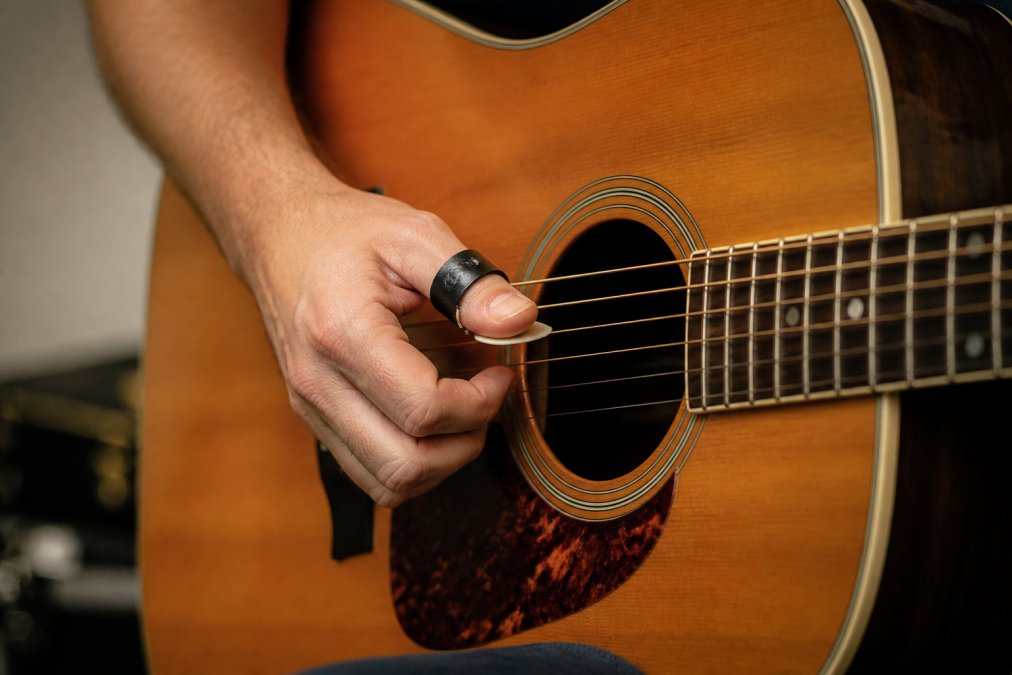
Strum-N-Comfort invented a new category of thumb picks called Crossover thumb picks, specifically designed to address this problem. The SharkTooth and Kodiak models are comfortable and flexible, fitting all thumb sizes without requiring the player to force their thumb into a fixed position.
What makes Crossover thumb picks particularly effective for players dealing with hand fatigue is how they support the Universal Picking Technique: the ability to move seamlessly between fingerstyle and flat-pick approaches without changing your grip or repositioning your hand. That constant repositioning, which players using standard picks or bare-thumb technique have to do, is a significant source of cumulative forearm tension.
David Oakes, former Musicians Institute Instructor and USC Professor, noted: "After just a few hours of play, I can truly say that this SharkTooth Pick produces less muscle fatigue." Gil Parris, RCA/BMG recording artist and guitarist for Blood, Sweat & Tears, described it as "definitely an improvement over conventional thumb picks for easily moving between fingerstyle and flat pick techniques."
The Crossover thumb pick system is compatible with your own flat picks, so you're not abandoning the picks you already play well with. You're adding a framework that holds everything together with less physical effort.
Age-Related Considerations and When to See a Doctor
Hand pain in guitarists doesn't affect all ages the same way.
Younger players (teens through early 30s) are most susceptible to overuse injuries from aggressive practice schedules. RSI and tendonitis are the primary concerns.
Players in their 40s and 50s often notice reduced joint mobility and slower recovery between sessions. This isn't a reason to stop playing; it's a reason to adjust practice structure, prioritize warm-ups, and be more deliberate about string action and ergonomic gear.
Players over 60 face the additional variable of arthritis, which affects joint mobility and grip strength. Many guitarists in this group find that lighter string gauges, lower action, and ergonomic picks allow them to continue playing comfortably for decades longer than they expected.
Regardless of age, these signals mean you should stop playing and see a physician or physical therapist:
- Pain that persists for more than 48 hours after stopping play
- Visible swelling or redness in the hand, wrist, or forearm
- Numbness or tingling that doesn't resolve with rest
- A sudden sharp pain during playing
- Weakness in grip that wasn't present before
According to physical therapy guidance from the American Physical Therapy Association, early intervention in repetitive strain conditions produces significantly better outcomes than waiting until symptoms become severe. A physical therapist who works with musicians can assess your specific technique, identify the mechanical source of your pain, and build a recovery and prevention plan that doesn't require you to stop playing entirely.
The goal isn't to play through pain. The goal is to play for decades.
Hand pain is one of the most frustrating obstacles a guitarist faces. The right combination of technique, setup, warm-up habits, and ergonomic tools resolves most cases before they become serious injuries. Strum-N-Comfort's Crossover thumb picks are comfortable, flexible, and highly effective in helping develop a Universal Picking Technique that works across both fingerstyle and flat-pick playing. If you're ready to reduce hand strain and play with more confidence, visit our secure Etsy shop and find the SharkTooth or Kodiak model that fits your playing style.
Frequently Asked Questions
How long until my fingers stop hurting from playing guitar?
For beginners, fingertip soreness from building calluses typically fades within 2 to 4 weeks of consistent practice. The skin hardens and fingertip sensitivity decreases over time. However, if you experience a dull ache, sharp pain, or numbness in your wrist, forearm, or palm, that is a different issue entirely. That kind of discomfort points to overuse injury or poor technique and will not resolve on its own without rest, recovery, and correcting the root cause.
What does guitar tendonitis feel like?
Guitar tendonitis usually starts as a dull ache or burning sensation along the forearm, wrist, or fingers that appears during or after playing. As inflammation progresses, you may notice sharp pain when gripping, strumming, or fretting, along with stiffness in the morning. Tingling or numbness can also develop if nearby nerves are compressed. Unlike normal muscle fatigue that clears after a short rest, tendonitis pain tends to linger and worsen if you continue playing without addressing your technique and practice intervals.
Can poor picking technique cause hand fatigue?
Yes, and it is one of the most common causes guitarists overlook. Gripping a pick too tightly, using excessive wrist rotation, or anchoring your forearm awkwardly all force your muscles to work harder than necessary. This builds forearm tension and accelerates muscle fatigue. Switching to a proper guitar picking technique, relaxed grip, neutral wrist alignment, and efficient motion, dramatically reduces the strain. Ergonomic tools like Crossover thumb picks are specifically designed to support this kind of relaxed, efficient right-hand technique.
How can I improve my guitar ergonomics to reduce pain?
Start with your guitar setup: lower string action reduces the force needed to fret notes, which cuts fretboard tension across both hands. For your right hand, focus on wrist alignment and avoid death-gripping your pick. Ergonomic guitar accessories, including supportive straps, cushioned armrests, and Crossover thumb picks, help maintain comfortable positioning during extended play. Short practice intervals with deliberate warm-up routines and post-session stretches round out a solid ergonomic approach that protects your hands over the long term.
This article was written using GrandRanker