 ultimate-guide
Why Use a Crossover Thumb Pick: A Guide
Table of Contents
- What Is a Crossover Thumb Pick?
- How Crossover Picks Differ from Traditional Thumb Picks
- Developing a Universal Picking Technique
- Ergonomic Guitar Picks for Hand Fatigue and Injury Prevention
- How to Transition from Flat-Picking to Fingerstyle
- Techniques You Can Master: Flat-Picking, Fingerstyle, and Hybrid Playing
- Adjustability, Fit, and String Attack Improvements
- Conclusion
- Frequently Asked Questions
Last Updated: September 4, 2026
What Is a Crossover Thumb Pick?
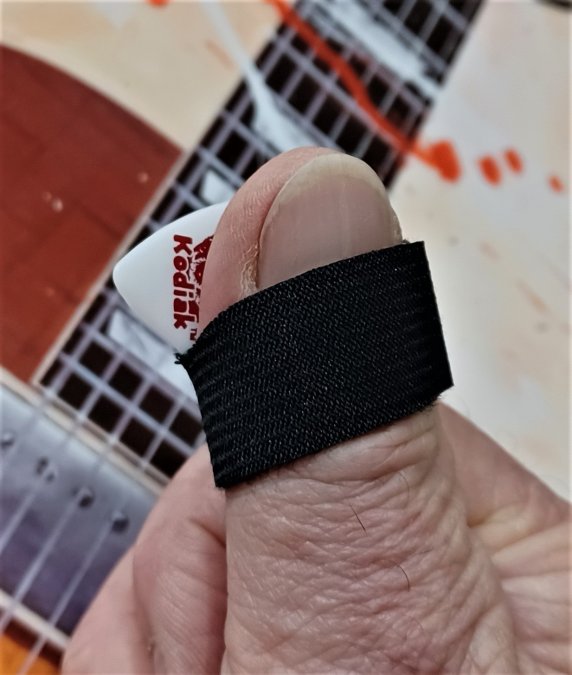
A crossover thumb pick is a new category of thumb pick that combines the stability of a traditional thumb pick with the flexibility to use your own flat pick, allowing seamless movement between fingerstyle and flat-picking techniques. This design frees your index and middle fingers for fingerstyle work while keeping a pick ready for strumming or lead lines, solving the awkward moment when you have to drop your flat pick to switch techniques mid-song.
The core insight is that your thumb should anchor the pick, not trap it. The design fits over your thumb and includes a slot for your preferred flat pick, letting you play fingerstyle with bare fingers, then rotate the pick into playing position without missing a beat.
How Crossover Picks Differ from Traditional Thumb Picks
Traditional thumb picks are molded as a single rigid piece with the pick blade fixed at one angle, forcing your hand into a specific position. Crossover thumb picks solve this by separating the thumb loop from the pick itself.
The practical differences come down to three things:
- Pick compatibility: You use your own flat pick, so gauge and material stay familiar.
- Angle adjustment: The pick sits at an angle that suits your hand, not the manufacturer's default.
- Finger freedom: Your fingers stay bare for fingerstyle, harmonics, and percussive slaps.
Most players notice the difference within the first few minutes, the pick feels like an extension of your natural picking motion rather than a foreign object, especially for players who have developed a specific pick angle.
Developing a Universal Picking Technique
A Universal Picking Technique is the ability to move fluidly between fingerstyle, flat-picking, and hybrid picking without changing tools or adjusting your grip. The crossover thumb pick makes this practical by keeping your options open at all times.
The technique builds on three core movements:
- Downstrokes and upstrokes with the flat pick for lead lines and strumming
- Fingerstyle patterns using your thumb for bass notes while fingers handle melody
- Hybrid picking where the pick handles one string while fingers pluck others simultaneously
The thumb's role changes depending on the technique: in flat-picking it drives the pick; in fingerstyle it plays bass lines independently. A crossover pick supports both by letting your thumb move naturally while keeping the pick accessible, enabling smoother transitions and greater confidence during live performance.
Ergonomic Guitar Picks for Hand Fatigue and Injury Prevention
Hand fatigue is a barrier for guitarists who practice for hours or play regular gigs. The repetitive motion of gripping a flat pick between your index finger and thumb creates tension that radiates through the hand and forearm. Ergonomic guitar picks address this by redistributing the workload across your entire hand.
A crossover thumb pick shifts the grip responsibility to your thumb, which is naturally stronger and more stable than a finger pinch. This reduces muscle strain in your index finger and allows your hand to stay relaxed during long sessions. David Oakes, former Musicians Institute instructor, observed that the SharkTooth Crossover Pick produces less muscle fatigue after just a few hours of play.
The ergonomic benefit is also relevant for players managing arthritis or joint discomfort. By eliminating the need to maintain a tight finger pinch, the crossover design lets you play with a more relaxed hand position, making extended practice more sustainable.
How to Transition from Flat-Picking to Fingerstyle
Transitioning from flat-picking to fingerstyle is easier when you understand the specific right-hand conflicts and how the crossover thumb pick design addresses them.
Flat-pick players develop a dominant grip pattern where index and thumb hold and drive the pick while other fingers stay passive. When you switch to fingerstyle, those passive fingers must become active for plucking while your thumb shifts from "pick driver" to "bass note player." This creates two problems:
- Grip memory conflict. Your index finger expects to be pinching the pick; when you remove it, that finger feels lost and tends to clench or hover awkwardly.
- Thumb role ambiguity. Your thumb is used to anchoring a pick; without one, it lacks a clear reference point for where to position itself on the strings.
A crossover thumb pick solves both by keeping your thumb's anchor point constant while freeing your index and middle fingers to learn fingerstyle independently. Your thumb has a physical reference (the pick holder), and your fingers can practice their new role without your thumb competing for attention.
Structured 30-Day Transition Plan:
Week 1: Anchor Awareness (5-10 minutes daily)
- Wear the crossover pick on your thumb with the flat pick tucked in the holder.
- Play simple fingerstyle patterns (thumb on bass notes, index and middle on higher strings).
- Focus on feeling your thumb's position relative to the strings. Goal: Your thumb should feel stable and centered.
Week 2: Finger Independence (10-15 minutes daily)
- Continue fingerstyle patterns from Week 1, adding percussive elements: light thumb slaps on the body, finger taps on the fretboard.
- Keep the flat pick tucked away. Goal: Your fingers should pluck cleanly without your thumb tensing in response.
Week 3: Pick Rotation Mechanics (10-15 minutes daily)
- Alternate one bar of fingerstyle with one bar of flat-picking, rotating the pick using only your thumb and index finger (no hand repositioning).
- Goal: The rotation should feel smooth with no hand adjustment; your wrist angle stays constant.
Week 4: Full Song Integration (15-20 minutes daily)
- Choose a song that alternates between fingerstyle and flat-picked sections.
- Play the song start to finish without stopping. If you stumble on a transition, isolate it for 2-3 minutes before returning to the full song.
- Goal: Complete the song without pausing or repositioning your hand between techniques.
Common Transition Mistakes:
- Rushing the timeline. Attempting Week 3 mechanics in Week 1 leads to tension. Muscle memory requires repetition.
- Over-gripping during fingerstyle. Many flat-pick players unconsciously clench their fingers. Consciously relax your index and middle fingers.
- Rotating the pick with your whole hand. The rotation should come from your thumb and index finger only. If your wrist or elbow moves, you are not building the fine motor control needed for seamless transitions.
- Practicing too long in one session. Two focused 10-minute sessions per day outperform one 20-minute session.
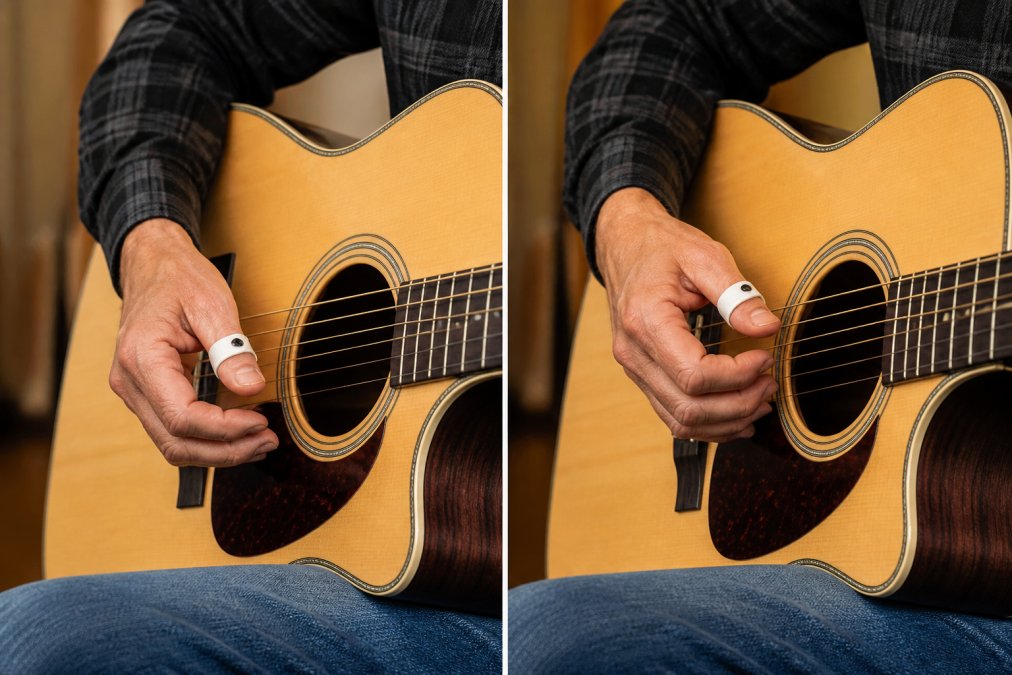
Most players who follow this progression report smooth transitions within 3-4 weeks. The crossover thumb pick's design keeps your thumb's anchor point constant, so your fingers can learn their new role without your thumb competing for attention.
Techniques You Can Master: Flat-Picking, Fingerstyle, and Hybrid Playing
The crossover thumb pick supports three distinct right-hand techniques for developing a Universal Picking Technique.
Flat-picking uses the pick for single-note runs, strumming, and rhythm work. The crossover design holds your flat pick securely while preserving your preferred pick gauge, attack, and tone.
Buy Now at our secure ETSY SHOP music store →
Fingerstyle uses the thumb for bass lines while fingers handle melody and harmony. Your fingers remain bare for full articulation and string attack control, while the thumb pick adds subtle brightness to bass notes.
Hybrid picking combines both approaches, using the pick for lower strings while fingers pluck higher strings. Gil Parris, RCA/BMG recording artist, described the SharkTooth as a definite improvement over conventional thumb picks for moving between fingerstyle and flat-pick techniques.
Technique | Primary Role of Thumb | Pick Position | Best For |
|---|---|---|---|
Flat-picking | Drives the pick | Active, in hand | Lead lines, strumming |
Fingerstyle | Plays bass notes | Tucked away | Arpeggios, fingerpicking |
Hybrid picking | Alternates both roles | Switches as needed | Country, jazz, fusion |
Adjustability, Fit, and String Attack Improvements
A crossover thumb pick only works well if it fits securely and allows your thumb to sit in a natural, neutral position. Fit and tone are mechanically linked, so understanding this relationship helps you troubleshoot both comfort and sound quality.
How Fit Determines Pick Angle and Tone:
When a crossover thumb pick fits properly, your thumb sits in a relaxed, neutral position at the base of your hand. The flat pick holder angles the pick at approximately 45-50 degrees to the strings, balancing three competing demands:
- String contact. At 45-50 degrees, the pick's edge makes solid contact with the string without digging in or glancing off.
- Articulation. The pick can move through the string cleanly on both downstrokes and upstrokes, producing clear note separation.
- Tone. The angle allows the pick to engage the string's full thickness, producing a warm, full tone rather than a thin or scratchy one.
If the pick holder is too loose or the loop is positioned too high on your thumb, your thumb rotates slightly, changing the pick angle. A steep angle produces a thin, bright tone and can cause the pick to catch on the string. A shallow angle produces a dull tone and requires more finger pressure.
This is why slippage and poor fit are not just comfort issues, they directly degrade your tone and attack.
Flexible Materials and Secure Fit:
The best crossover thumb pick designs use flexible materials (such as Neoprene or twill Nylon) that conform to your thumb's shape while maintaining consistent tension. This flexibility serves two functions:
- Pressure distribution. Flexible materials distribute pressure evenly across the contact surface, allowing you to play for hours without soreness.
- Adaptive grip. As your hand temperature and moisture level change during playing, flexible materials adjust their grip slightly without losing contact. A rigid pick often slips as your hand perspires.
Custom Crossover thumb picks are engineered to fit all thumb sizes comfortably while maintaining the precise pick angle needed for consistent tone and articulation. The flexibility reduces pressure points and maintains grip stability even during aggressive playing or extended sessions.
String Attack and Tone Control:
String attack, the clarity and definition of each note, improves because the pick angle is controlled by your thumb's natural position rather than a fixed mold. When your thumb sits comfortably in a neutral position, your wrist and forearm naturally align for smooth, controlled picking motions.
This alignment produces clean articulation on downstrokes and prevents the "scratchy" upstroke tone that many players experience with poorly fitted picks.
Players also report better tone quality because they can adjust the pick's contact point with the string to suit their preferred sound. If you prefer a brighter tone, angle your thumb slightly to increase the pick's edge engagement. If you prefer a warmer tone, increase the pick's flat surface contact. This fine-tuning is only possible when the fit is secure and your thumb position is stable.
Compatibility with Your Preferred Flat Pick:
For players using the crossover system with their own flat picks, the adjustability extends to pick gauge and material. Whether you prefer a thin pick for strumming or a heavy pick for lead work, the holder accommodates your choice. You maintain the exact tone and feel you have spent years developing.
Many players consider the crossover thumb pick a permanent part of their setup because this flexibility preserves their existing picking preferences while gaining ergonomic and technique-development benefits.
Conclusion
The crossover thumb pick solves a problem that has frustrated guitarists for decades: how to switch between picking techniques without breaking your flow. By combining the stability of a thumb pick with the familiarity of your own flat pick, it supports a Universal Picking Technique that keeps your options open.
At Strum-N-Comfort, we designed the SharkTooth and Kodiak crossover picks to be comfortable, flexible, and highly effective for developing a Universal Picking Technique. Our picks fit all thumb sizes, reduce muscle fatigue, and work with the flat picks you already own. Explore our Crossover thumb pick collection and feel the difference in your playing.
Frequently Asked Questions
What is a crossover thumb pick?
A crossover thumb pick is a new category of thumb pick designed to let guitarists seamlessly combine fingerstyle and flat-picking techniques in one playing session. Unlike traditional thumb picks that lock your hand into one approach, crossover thumb picks are comfortable, flexible, and engineered to support what we call the Universal Picking Technique. They let your right hand move fluidly between techniques without removing or switching picks.
Can a crossover thumb pick really reduce hand fatigue?
Yes. Crossover thumb picks are built with ergonomics in mind to reduce the muscle tension and strain that come from repetitive picking motion. By distributing pressure more evenly across your thumb and supporting proper hand biomechanics, they lower the fatigue that builds during extended practice or live sets. Many players report noticeable relief after just a few hours of play, especially if you've been switching between techniques frequently.
How do I know if a crossover thumb pick will fit my hands?
Crossover thumb picks are designed with adjustability in mind to accommodate different thumb sizes and hand shapes. The tension and fit can be customized to suit your hand, whether you have small, average, or large fingers. This adjustability means you're not locked into a one-size-fits-all product. Visit our secure ETSY SHOP music store to explore options and find the fit that works best for your playing style.
What's the difference between a crossover thumb pick and a regular thumb pick?
Traditional thumb picks force you to choose one playing style, and switching between fingerstyle and flat-picking often means removing the pick or struggling with awkward hand positions. Crossover thumb picks eliminate that friction. They're engineered specifically to let your right hand transition smoothly between techniques while maintaining comfort, stability, and control. This flexibility is what makes them effective for developing the Universal Picking Technique.
This article was written using GrandRanker
Frequently Asked Questions
Q: What is a crossover thumb pick?
A: A crossover thumb pick is a new category of thumb pick designed to let guitarists seamlessly combine fingerstyle and flat-picking techniques in one playing session. Unlike traditional thumb picks that lock your hand into one approach, crossover thumb picks are comfortable, flexible, and engineered to support what we call the Universal Picking Technique. They let your right hand move fluidly between techniques without removing or switching picks.
Q: Can a crossover thumb pick really reduce hand fatigue?
A: Yes. Crossover thumb picks are built with ergonomics in mind to reduce the muscle tension and strain that come from repetitive picking motion. By distributing pressure more evenly across your thumb and supporting proper hand biomechanics, they lower the fatigue that builds during extended practice or live sets. Many players report noticeable relief after just a few hours of play, especially if you've been switching between techniques frequently.
Q: How do I know if a crossover thumb pick will fit my hands?
A: Crossover thumb picks are designed with adjustability in mind to accommodate different thumb sizes and hand shapes. The tension and fit can be customized to suit your hand, whether you have small, average, or large fingers. This adjustability means you're not locked into a one-size-fits-all product. Visit our secure ETSY SHOP music store to explore options and find the fit that works best for your playing style.
Q: What's the difference between a crossover thumb pick and a regular thumb pick?
A: Traditional thumb picks force you to choose one playing style, and switching between fingerstyle and flat-picking often means removing the pick or struggling with awkward hand positions. Crossover thumb picks eliminate that friction. They're engineered specifically to let your right hand transition smoothly between techniques while maintaining comfort, stability, and control. This flexibility is what makes them effective for developing the Universal Picking Technique.