 comparison
Best Pick Thickness for Electric Guitar: A 2026 Guide
Table of Contents
- How Pick Thickness Shapes Your Electric Guitar Sound
- Electric Guitar Pick Thickness Chart: Gauge Ranges in Millimeters
- Thin vs. Thick Guitar Picks: Flexibility, Control, and Tone
- Best Guitar Pick Thickness for Lead Playing and Fast Passages
- Best Guitar Pick Thickness for Strumming and Rhythm Playing
- Same Pick, Different Gauges: A Controlled Comparison
- Matching Thickness to Genre, String Gauge, and Playing Comfort
- A Practical Decision Guide for Moving Between Thicknesses
- Frequently Asked Questions
Last Updated: October 17, 2026
How Pick Thickness Shapes Your Electric Guitar Sound
Pick thickness is the single most overlooked variable in an electric guitarist's rig. At Strum-N-Comfort, we build Crossover thumb picks, so we spend a lot of time thinking about the right hand.
Here is the part most guides get wrong: thickness is not a "tone knob" you set once. It is a technique multiplier. A stiff pick rewards a player with controlled wrist motion and punishes one who muscles through chords.
Why the Picking Hand Deserves as Much Attention as the Fretting Hand
Your fretting hand gets scales, drills, and hours of practice. Your picking hand often gets a pick chosen by habit. That imbalance shows up in speed ceilings, inconsistent attack, and forearm fatigue. A common mistake is buying a heavier pick to "get more tone" without adjusting technique to match it. The pick and the hand have to agree.
Another important element regarding pick technique, and its effect on tone, is the material that the pick is made from. This subject deserves it’s own article later on, and therefore, is not discussed here.
Electric Guitar Pick Thickness Chart: Gauge Ranges in Millimeters
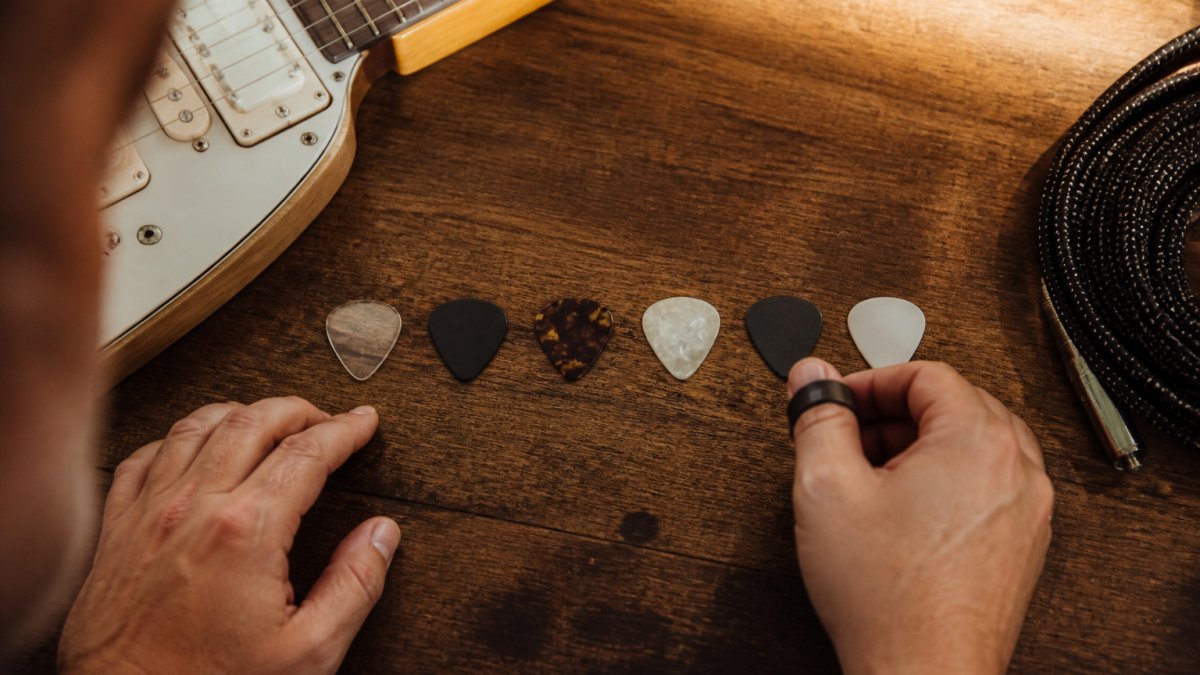
Electric guitar picks run from roughly 0.38 mm to 3.5 mm, grouped into four practical bands: thin, medium, heavy, and extra-thick. Those bands are not arbitrary.
Category | Range (mm) | Feel | Best For |
|---|---|---|---|
Thin | 0.38-0.65 | Very flexible | Acoustic-style strumming, soft attack |
Medium | 0.65-1.00 | Some give | Rhythm, mixed styles, beginners |
Heavy | 1.00-1.50 | Firm | Lead lines, precise picking |
Extra-thick | 1.50-3.50 | Rigid | Fast passages, tight control |
Different makers draw the lines slightly differently. Rombo's pick selection guide defines medium gauge as 0.55 mm to 1 mm and treats anything above 1 mm as thick.
Thin vs. Thick Guitar Picks: Flexibility, Control, and Tone
Thin picks flex; thick picks resist. That single difference drives everything else, from how a chord blooms to how a fast lick articulates. Thin vs. thick guitar picks is really a question about what you want your right hand to feel.
How Thickness Changes Flex and String Resistance
A thin pick bends as it crosses the string, so it releases energy gradually and softens the attack. A heavy pick barely deforms, so the string feels stiffer under your hand and responds with a sharper snap. Players moving up in gauge often report that their picking hand has to work less to get the same volume. That is the stiffness doing the work.
Pick Attack, Brightness, and Warmth
Pick attack is the transient at the front of every note. Stiff picks produce a more defined attack with brighter highs. Flexible picks round that edge off and can sound warmer and softer. On a clean amp, the difference is obvious. Under heavy gain, a thick pick's sharper attack can sound aggressive; a thin pick can sound mushy. Match the pick to the gain level, not the other way around.
Best Guitar Pick Thickness for Lead Playing and Fast Passages
The best guitar pick thickness for lead playing sits in the heavy range, roughly 1.0 mm to 1.5 mm, with many advanced players going higher.
Chicken Picks' electric guitar pick guidance notes that many advanced electric players prefer picks between 1.5 mm and 3.5 mm for control and note attack.
Where it falls short: a 2 mm pick is a poor choice for wide, relaxed strumming.
Best Guitar Pick Thickness for Strumming and Rhythm Playing
The best guitar pick thickness for strumming lands in the medium range, about 0.60 mm to 0.80 mm. A little flex lets the pick glide across the strings instead of catching, which keeps chord transitions smooth and reduces string noise.
Rhythm playing rewards forgiveness. If your strumming hand is tense, a flexible pick hides it. If you play funk or ska with tight sixteenth-note strums, a medium pick keeps the attack consistent without the pick flapping.
Same Pick, Different Gauges: A Controlled Comparison
A controlled comparison isolates one variable: thickness. Same material, same tip shape, same player, same amp.
Most guides compare different picks from different brands, which muddies the result.
Here is how we would run the test on electric guitar:
- Pick one riff with open chords and one with fast single notes on the same guitar.
- Set a clean amp tone with no pedals, then repeat with a moderate gain tone. Pick attack differences are clearest clean and most consequential under gain.
- Play both riffs at the same amp settings with a thin, medium, heavy, and extra-thick pick from the same product line.
- Record each pass on your phone at the same position, and also track a DI part if you have an interface. The DI captures the raw transient; the mic'd or amp-sim part shows how the tone sits in a mix.
- Listen back for attack, brightness, pick noise, and how the note decays, not just "feel."
- Note which gauge made your hand work hardest and where your grip tension rose.
The recording step matters. In the room, your ears adjust in seconds. On playback, the differences in attack and warmth are unmistakable.
Buy SharkTooth and Kodiak flat picks Now at our secure ETSY SHOP music store →
warning Do not judge thickness on a high-gain channel alone.
Matching Thickness to Genre, String Gauge, and Playing Comfort
Thickness does not exist in a vacuum. String gauge, genre, and hand comfort all push the decision in different directions. Picking technique and string gauge interact more than most players realize: heavier strings resist more, so a stiff pick compounds that resistance. The goal is a right hand that can combine techniques, strumming, single-note picking, and fingerstyle, without rebuilding its mechanics every time.
Genre and Technique Starting Points for Electric Guitar
- Rock and metal lead: 1.0-1.5 mm for tight, aggressive attack. Under high gain, a stiff pick keeps the transient defined and the low end from blurring.
- Blues and classic rock: 0.88-1.14 mm for a balance of snap and warmth. This range forgives a slightly angled attack and keeps bends articulate.
- Funk and rhythm: 0.60-0.88 mm for consistent, snappy strums. A little flex helps sixteenth-note strums stay even without flapping.
How String Gauge and Right-Hand Technique Interact
If you play 9-gauge strings with a light touch, a heavy pick can feel like overkill and add harshness. If you play 11s and dig in, a thin pick will fold under your hand. Match the pick's stiffness to how hard you actually strike the string, not how hard you think you should. Attack angle matters too: a pick held flat to the string feels stiffer than the same pick angled slightly, so a player who angles the pick can often use a heavier gauge without fighting it.
Comfort, Fatigue, and Long Practice Sessions
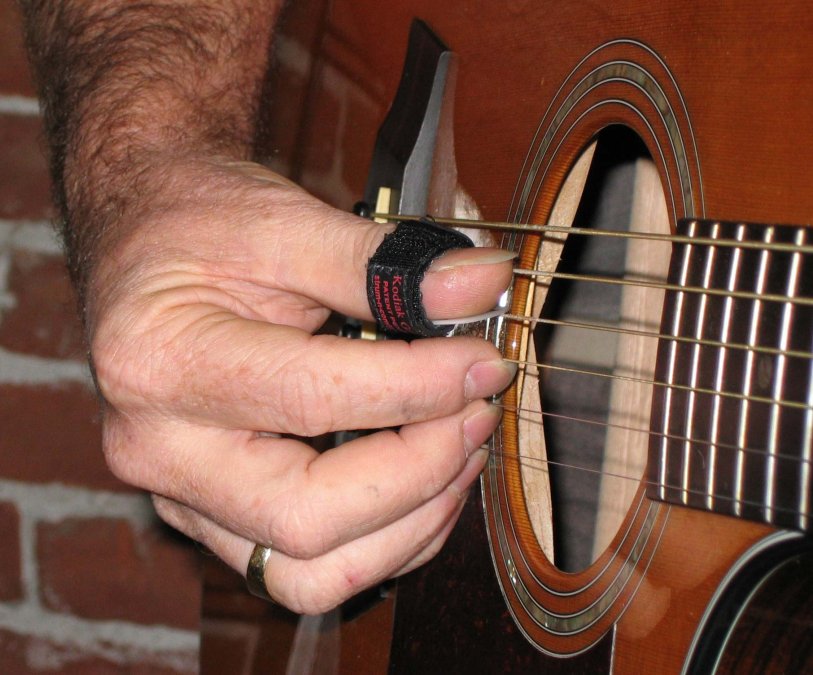
Grip comfort is part of thickness selection. A stiff pick needs less squeeze, not more; players who grip hard to control a thin pick often feel forearm fatigue first. If your hand aches after 30 minutes, check two things: whether the gauge is too thin for your attack, and whether your grip pressure is too high. A comfortable, flexible Crossover thumb pick with a fully adjustable thumb strap system can reduce the grip tension that builds over a long session and help you combine strumming and picking with one right-hand approach.
Recording and Amplified Tone Checks
In a mix, thick picks tend to sit forward with clear articulation; thin picks can blur under compression. Before you commit to a gauge, track a DI part and a mic'd part and compare. The pick that sounds best solo is not always the one that sits best in a mix.
The right pick thickness is the one that lets your right hand do its job with the least compensation. If you are fighting the pick, change the pick, not your technique.
A Practical Decision Guide for Moving Between Thicknesses
Moving between thicknesses is a skill in itself, and it is where a universal picking technique pays off. The goal is a right hand that can strum, pick, and switch to fingerstyle without rebuilding its mechanics every time.
Our comfortable, flexible Crossover thumb picks help players develop what we call a Universal Picking Technique: one right-hand approach that covers fingerstyle and flat-pick playing.
Here is how we would approach the transition:
- Spend one week on the new gauge with slow, deliberate picking.
- Keep your old pick nearby for gigs until the new one feels automatic.
- Reduce grip pressure; stiff picks need less squeeze, not more.
Players who switch between fingerstyle and flat-picking mid-set and want one comfortable, adjustable system instead of juggling picks between songs.
The best pick thickness for electric guitar is not a single number. It is the gauge that matches your technique, your strings, and your genre, and the players who improve fastest are the ones willing to test rather than assume. If you want to develop a right hand that handles any thickness, explore the SharkTooth and Kodiak Crossover picks and start building your Universal Picking Technique today.
Frequently Asked Questions
What pick thickness is best for electric guitar?
There is no single answer, but most electric players land in two zones: 0.6 mm to 0.8 mm for flexible strumming and 1.0 mm and up for controlled lead work. Dunlop's Tortex .88 mm sits in the middle and is a common starting point. Rombo's guide treats 0.55 mm to 1 mm as medium gauge and anything over 1 mm as thick. Buy two or three gauges in the same shape and material, then let your picking hand decide.
Are thin or thick picks better for electric guitar?
Thin picks flex against the string, which softens attack and makes wide strumming feel forgiving. Thick picks stay rigid, so more of your hand motion reaches the string, which gives tighter note control and a firmer attack for single-note lines. The trade-off is real: a very thin pick can feel floppy on fast alternate picking, and a very heavy pick can feel stiff during big chord strums. Most players keep both on the amp.
What thickness should I use for lead playing versus strumming?
For lead playing, start around 1.0 mm to 1.5 mm. Chicken Picks notes that many advanced electric players prefer 1.5 mm to 3.5 mm for control and note attack. For strumming, a 0.6 mm to 0.8 mm pick gives you flex and a lighter attack across the strings. If you switch between both in one song, a medium pick around 0.88 mm is the least disruptive compromise.
Can one pick thickness work for both strumming and lead guitar?
Yes, with a compromise. A medium pick around 0.8 mm to 1.0 mm handles chord work and single-note lines without forcing you to swap mid-set. It won't be as springy as a thin pick for wide strums or as rigid as a heavy pick for fast alternate picking, but it keeps your right hand consistent. Players who combine fingerstyle and flat-picking often prefer a strap-based thumb pick system so the pick stays in place while fingers stay free.
Does pick thickness really change electric guitar tone?
It changes attack more than the amp's core sound. A thin pick bends on contact, so the note blooms slightly later and sounds softer and rounder. A thick pick transfers energy immediately, which reads as a sharper attack, more articulation, and often more brightness in the upper mids. Through a clean amp the difference is easy to hear; with heavy distortion it shows up as tighter or looser low-end response and how much string noise comes through.
Your right hand should not have to choose between comfort and control. At Strum-N-Comfort, our Crossover thumb picks combine a fully adjustable thumb strap system with a flexible, comfortable fit that helps you move between fingerstyle and flat-picking without missing a beat. The SharkTooth model even lets you keep your favorite flat pick in the strap. Get started with Strum-N-Comfort and build a Universal Picking Technique that works with any thickness you play.